


Connecting the Dots: How new coach Eric Morris is rebuilding Cowboy football
Wednesday, May 13, 2026
Media Contact: Mack Burke | Associate Director of Media Relations | 405-744-5540 | editor@okstate.edu
It’s been over 100 years since dietitian Lenna Cooper became the first person credited with claiming breakfast as the most important meal of the day.
New Oklahoma State University football coach Eric Morris may not be channeling Cooper, but he has made the morning meal a cornerstone of an offseason program designed to help a roster of mostly strangers turn into a cohesive football team.
In an era of transient players, coaches and even conference membership, Morris is a connector at a time when it is most needed.
“Building trust is one of the most important things in any organization,” Morris said from his still bare-bones office atop Boone Pickens Stadium well into his fourth month in Stillwater.
“You must be very intentional in building a culture and creating trust in building these relationships. And it’s one of my favorite things to do on a day-to-day basis.”
Thus, “The Breakfast Club” was born.
“We have our coaches eat with different members of our roster twice a week,” Morris said. “That way, our defensive line coaches are sitting down with running backs, and our offensive line coaches eat with the defensive backs. People who really aren’t spending a lot of time together have breakfast together.
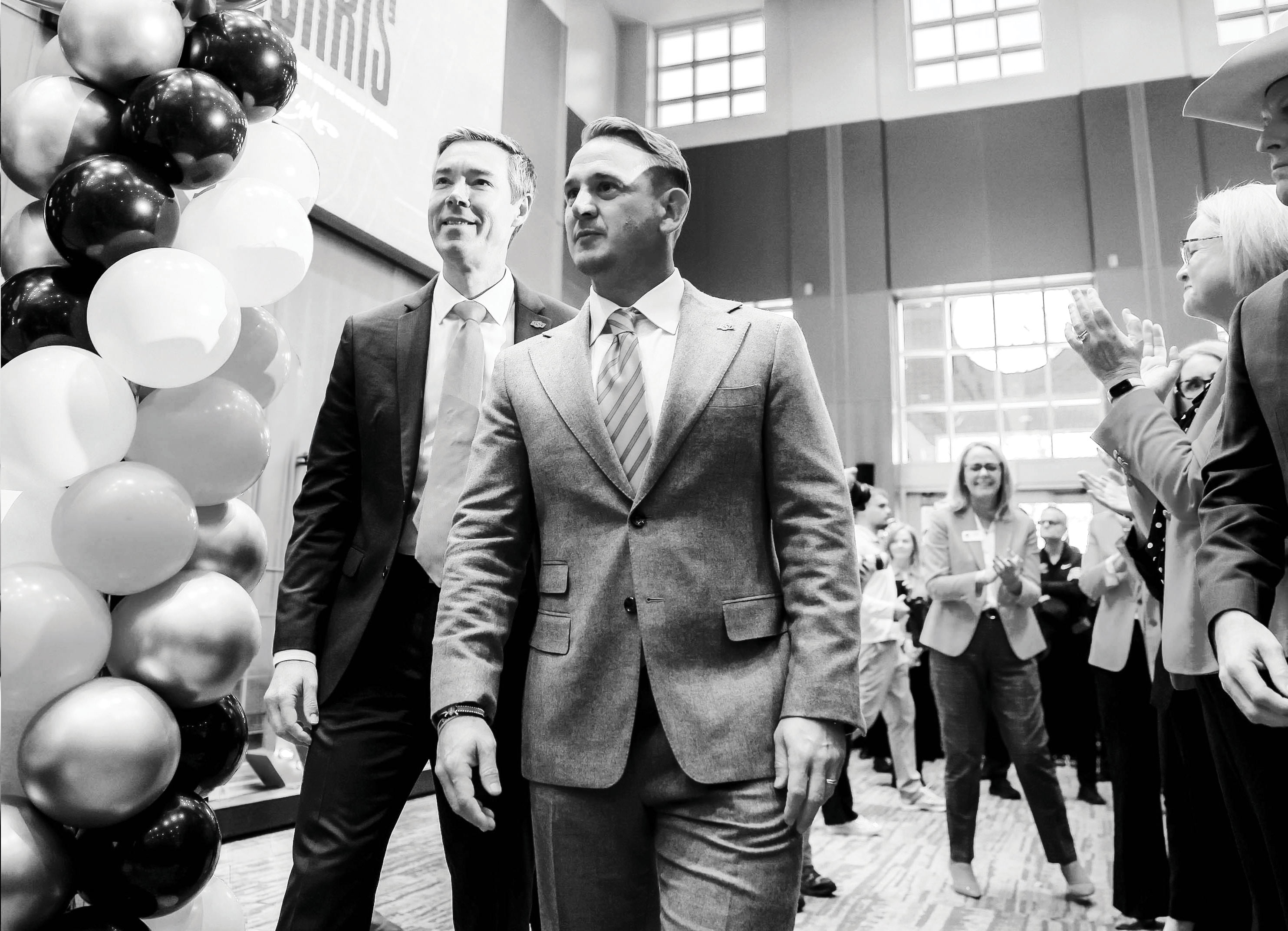
“I have always thought that tough teams win football games. This is an extremely physical, violent sport, and if you go to war on Saturdays with your brothers, you are willing to sacrifice for one another. That’s an element I think gets lost nowadays with the portal. I enjoy spending time with these kids, and we are very intentional around here about making sure we do that.”
Unlike any coach in recent or even ancient OSU football history, Morris arrived in Stillwater as a tried-and-true head coach with two program flips already under his belt — at the University of Incarnate Word in San Antonio and at the University of North Texas in Denton. OSU is not his maiden voyage, and in his mental briefcase is a list of his accomplishments and missteps. His philosophies have been sharpened by real-world experiences gained by sitting in the big chair.
“My first head coaching job was at a small place in Incarnate Word,” he said. “It was a place where I could make mistakes without being under the magnifying glass all of the time, and it allowed me to grow and learn and get a feel for how to be a better leader.”
He was a fast learner. In four years at UIW, he was named conference coach of the year two times and twice led a program with few accomplishments into the Football Championship Subdivision playoffs. And then, he made what might be considered a unique career move. Instead of setting sights on his next head coaching gig, he became the offensive coordinator at Washington State University under coach Jake Dickert, who is now the head coach at Wake Forest University.
“It was probably one of the most valuable things I have done in my career,” Morris said. “It was my first time working with a defensive-minded head coach. It helped me see coaching from a different mindset, especially during practice. They (Washington State) set up drills that were designed to make the defense successful. And I saw that build confidence in the defense.
“Even though I call the plays, I want the defense to be successful, and I want those times to be celebrated because playing great defense allows you to win championships.”
Morris, of course, cut his teeth as a player and assistant coach on the Texas Tech University tree, playing under and working for the likes of Mike Leach, Kliff Kingsbury, Dana Holgorsen and Kevin Sumlin as part of some of the most prolific offenses in NCAA history.
The experience at WSU led Morris to the head coaching position at UNT, where the three-year stay resulted in a turnaround that followed a path similar to that of UIW. His first team in Denton was 5-7. His last team in 2025 may have been the best in that school’s history, winning 12 games, making a push for the College Football Playoff, playing for the American Athletic Conference championship and finishing No. 24 in the final Associated Press poll — a first for the Mean Green.
The turnaround in Denton led to Morris reuniting with former TTU deputy athletic director Chad Weiberg, now the vice president and director of OSU Athletics. The new coach has the assignment of righting a ship that had suddenly and quickly taken on water.
The link to Weiberg was an underpublicized but important element for Morris.
“It was important knowing who you were going to work for and what their leadership styles were,” he said. “Once I got into deeper conversations with Chad and Reid (Sigmon, deputy athletic director), I think it became more evident that we were on the same page in so many different aspects of getting this place built back up to what it was just a short time ago.”
In the Beginning
Some would argue that no one has a busier life than a college football coach. The exception might be the college coach with two jobs.
Just before Thanksgiving, OSU announced Morris as the 25th head coach in school history. He was a rising star whose name kept popping up in connection with numerous job searches in a year marked by ridiculous churn at the highest level of the sport.
Meanwhile, in Denton, UNT was in the midst of a season that was historic by its normal standards. North Texas was an offensive machine, drawing national headlines in a season that saw every Mean Green game become bigger than the previous.
But Morris and Weiberg had taken the drama out of things early — first agreeing on a contract that would make Morris the new Cowboy in charge, while also agreeing that as long as UNT was in playoff contention, Morris would remain coaching the Mean Green.
“This (transition) was a little out of the ordinary because when I took the other two jobs, I was able to transition my mind right away,” Morris said. “I was able to move to Incarnate Word immediately and have my sole focus on Incarnate Word. The same thing with North Texas. I was able to fly in on the same day, get to Denton and really start hammering away.
“Building trust is one of the most important things in any organization. You must be very intentional in building a culture and creating trust in building these relationships.
And it’s one of my favorite things
to do on a day-to-day basis.”
“This time was different. Usually, staff is the most important thing to me, and nowadays, with the transfer portal, there is roster transition, so this one was a little bit different. And we were still playing football and competing for a conference championship with the chance to make the College Football Playoff.”
Weiberg said Morris’ desire to finish the season with his team is indicative of why OSU hired him.
“The timing of these transitions are never great,” Weiberg said. “But he wanted to see things through with his team, with his players. It further cemented everything we thought we were getting with him.”
Although he wanted to work both jobs for as long as the Mean Green were in CFP contention, it didn’t mean it was easy.
“There were a lot of late nights as far as game planning and doing things I would normally be doing for North Texas,” Morris said. “But the recruiting aspect switched to Oklahoma State. I spent a lot of time digging into the current roster and figuring out who I needed to retain, and also trying to familiarize myself with the financial piece, getting the books for this place and seeing where we were from the financial aspect. The good news is that I pretty much brought everyone with me, so it was huge to have Raj and Steve start working through the roster, the portal and how we were going to manage high school recruiting.”
Raj Murti serves as the squad’s general manager, and Steve Keasler is the special assistant to the head coach. Both men manage the all-important business side of Cowboy football.
After North Texas fell to Tulane University in the AAC game, Morris turned his focus full time to OSU while most of the North Texas staff remained in Denton to coach the Mean Green to an eventual victory over San Diego State University in the New Mexico Bowl.
“That phase was tough for me,” Morris said. “I was up here three or four weeks by myself while everyone else stayed in Denton for the bowl. It was an important piece for us — for North Texas to win its first bowl game since 2013.
“It was lonely in this building for the first couple of weeks. It’s a great space, and I was walking up and down the empty hallways. It wasn’t always a great feeling when you are a new leader of a program of this magnitude. It was a wide array of emotions. I was extremely happy to have this opportunity and to be able to move my family to a place like Stillwater.
Morris and his wife, Maggie, have two sons, Jack and George. They were all still in Texas.
“They say it’s lonely at the top, and I definitely felt that because there were so many moving parts and everything was happening so fast,” Morris said.

A New Home
Just months into his new gig at OSU, Morris is still becoming acquainted, from the inside, with OSU. And he likes what he sees.
“The people are so friendly and nice and want to help you any way they can,” Morris said. “It’s been really refreshing for me and my family just to see how genuine the people are and how much they want to help. There are some people who see a small town as a negative. It was one of the biggest positives for my family. We get the small town feel while also being able to coach and compete on a national stage.”
The national stage starts in Stillwater, which is something that Morris not only understands but is excited to embrace.
“The football team at Oklahoma State is such a powerful thing for this campus,” he said. “I have seen it at so many different stops. It drives activities for students, and it creates so many experiences they will remember for the rest of their lives.”
He’s talking about building connections — lifetime connections for students to their alma mater because he is a connector.
It was his connection to Weiberg that helped him land in Stillwater. Connections with his family are the centerpiece of his life. Connecting with his players is his favorite part of being a college football coach.
He sees connecting his Cowboy football team with OSU students and the local community as not just necessary, but as a critical piece of program building.
And it all starts with a good breakfast.
See an expanded version of this article in the spring 2026 issue of POSSE magazine.
Photos by: Bruce Waterfield
Story by: Kevin Klintworth | STATE Magazine