

PhilanthroPete powers access to life-changing camp experiences
Wednesday, May 13, 2026
Media Contact: Mack Burke | Associate Director of Media Relations | 405-744-5540 | editor@okstate.edu
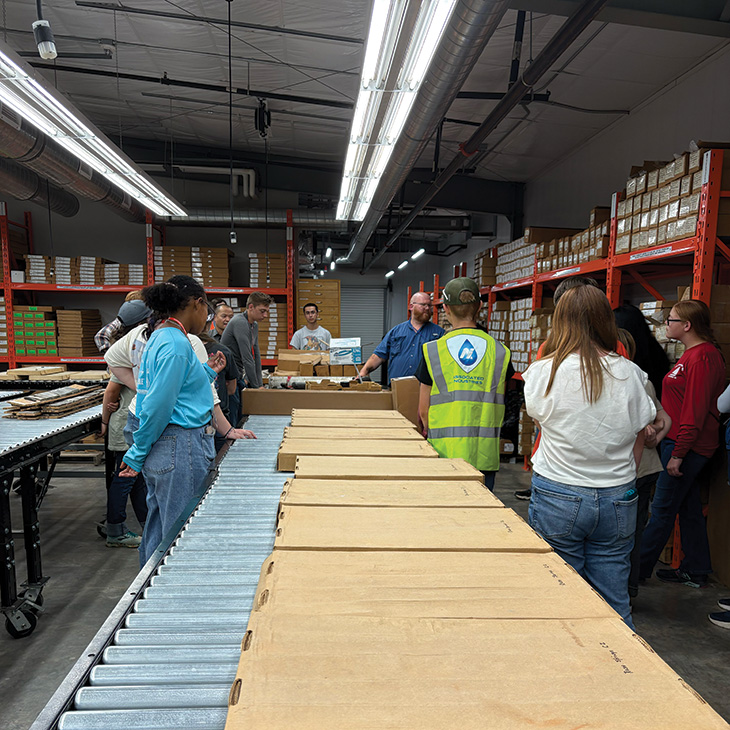
On the final day of the Summer Geoscience Research Experience (GEO‑REx) Camp, proud parents, faculty mentors and alumni gather as high school students present their research.
Just a few days earlier, many of them had never studied microscopic marine organisms preserved in deep‑sea sediments or used Light Detection and Ranging (LIDAR) imagery to map volcanic lava flows.
Now, after a week on the Oklahoma State University-Stillwater campus, they can confidently explain their experiments and why their work matters.
For Tracy Quan, director of outreach for the Boone Pickens School of Geology and organizer of GEO‑REx, those moments reflect the camp’s purpose.
“The campers are always highly focused on their experiments and eager to explain what they’re doing, which shows that they’re learning,” Quan said.
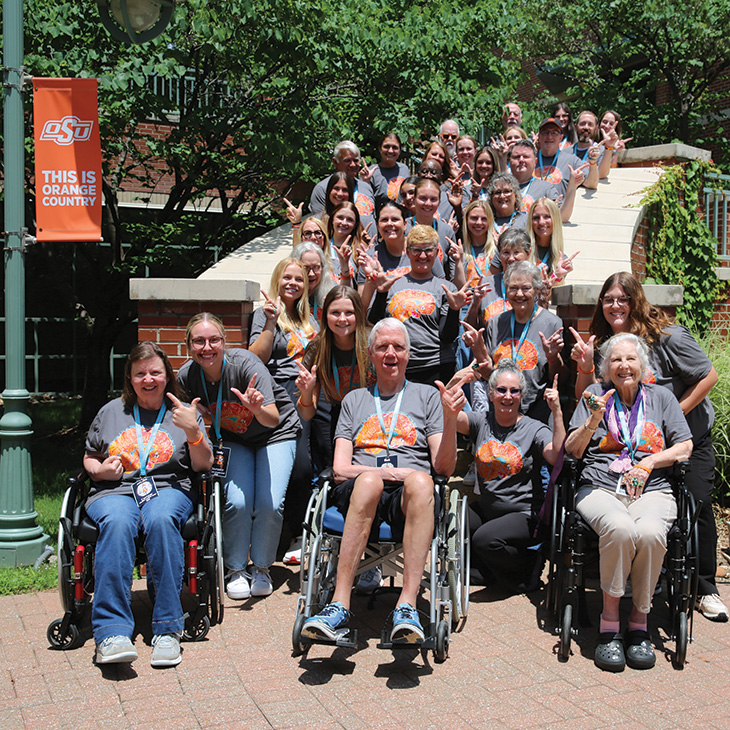
Across the state, at Cowboy Aphasia Camp, voices overlap as laughter and stories fill the room.
People living with the language disorder of aphasia gather at OSU-Tulsa each morning alongside graduate students studying communication sciences and disorders. Some words come slowly. Others arrive all at once.
“So many words are flying that you might not guess some of the people have aphasia,” said Karen Copeland, organizer of Cowboy Aphasia Camp.
Although these two camps serve very different communities, they share a common thread. Both exist year after year thanks to sustained donor support through PhilanthroPete, OSU’s crowdfunding platform that helps keep dozens of programs across the university growing and accessible.
For GEO‑REx, PhilanthroPete support makes participation possible. The camp was created to introduce high school students to geoscience — a field many would not otherwise encounter in their coursework. Through hands‑on, immersive experiences, GEO‑REx exposes students to a range of geoscience topics and careers while demonstrating how the field connects to real‑world challenges.
Thanks largely to donors, the campers’ meals, dorm stays, supplies and research experiences are fully covered, removing financial barriers that might otherwise prevent students from participating.
“We aim to introduce geoscience to high school students regardless of their level of resources,” Quan said.
Now in its fifth year, GEO‑REx is helping shape the Boone Pickens School of Geology’s future. Several former campers are currently enrolled, or soon will be, as geology, geophysics or environmental geoscience majors at OSU, showing how early exposure can open doors students may not have known existed.
At Cowboy Aphasia Camp, donor support is equally essential. Aphasia is most often caused by stroke or other neurological injuries. While recovery can continue for years, insurance‑covered therapy often does not. The camp helps fill that gap by creating a space where communication, confidence and connection can continue to grow.
The camp also provides graduate students with hands‑on clinical experience grounded in a life-reaching approach to therapy.
“It’s always rewarding to see people with aphasia become the real teachers for our graduate students and for the graduate students to stretch their wings as soon‑to‑be speech pathologists,” Copeland said.
PhilanthroPete funding covers most Cowboy Aphasia Camp expenses each year, keeping costs low for participants while supporting meals, therapy materials and clinical supervision. Over time, the camp has served more than 75 campers and trained more than 150 graduate students.
Donor support also allows the program to evolve, including a new Caregiver Day this year that gives families a space to connect, learn and support one another.
The impact of both camps extends well beyond a single week. Students discover new career paths, people with aphasia regain confidence and connection, and families experience lasting communication gains, all made possible through sustained PhilanthroPete donor support.
“On behalf of the people with aphasia who attend, and the students who work with them, thank you from the bottom of my heart,” Copeland said.
Quan echoes that gratitude.
“I hope that we’ve conveyed to donors how critical their support is to the camp and what their donations allow us to do,” she said.
Photos by: Provided
Story by: Estefania Martinez | STATE Magazine