

CHE team publishes findings on breakthrough soil moisture monitoring
Monday, January 12, 2026
Media Contact: Tanner Holubar | Communications Specialist | 405-744-2065 | tanner.holubar@okstate.edu
As global agricultural needs continue to rise, the need to be able to measure how much water permeates soil also increases.
It is estimated that one out of three counties in the United States experience severe drought or worse, with irrigated farms losing approximately $30 billion a year due to drought.
Despite the pressing need for more efficient irrigation water management to battle agricultural drought, only 12% of irrigated farms in the U.S. have installed soil moisture sensors, which measure soil moisture one meter into the ground. These sensors are challenging to deploy due to a lack of understanding of the spatiotemporal patterns of soil sensor measurements at this depth due to soil composition and variations in topography in a field of crops.
Researchers in the School of Chemical Engineering in the College of Engineering, Architecture and Technology at Oklahoma State University have developed an innovative computational method to greatly improve the speed, accuracy and reliability of soil moisture modeling.
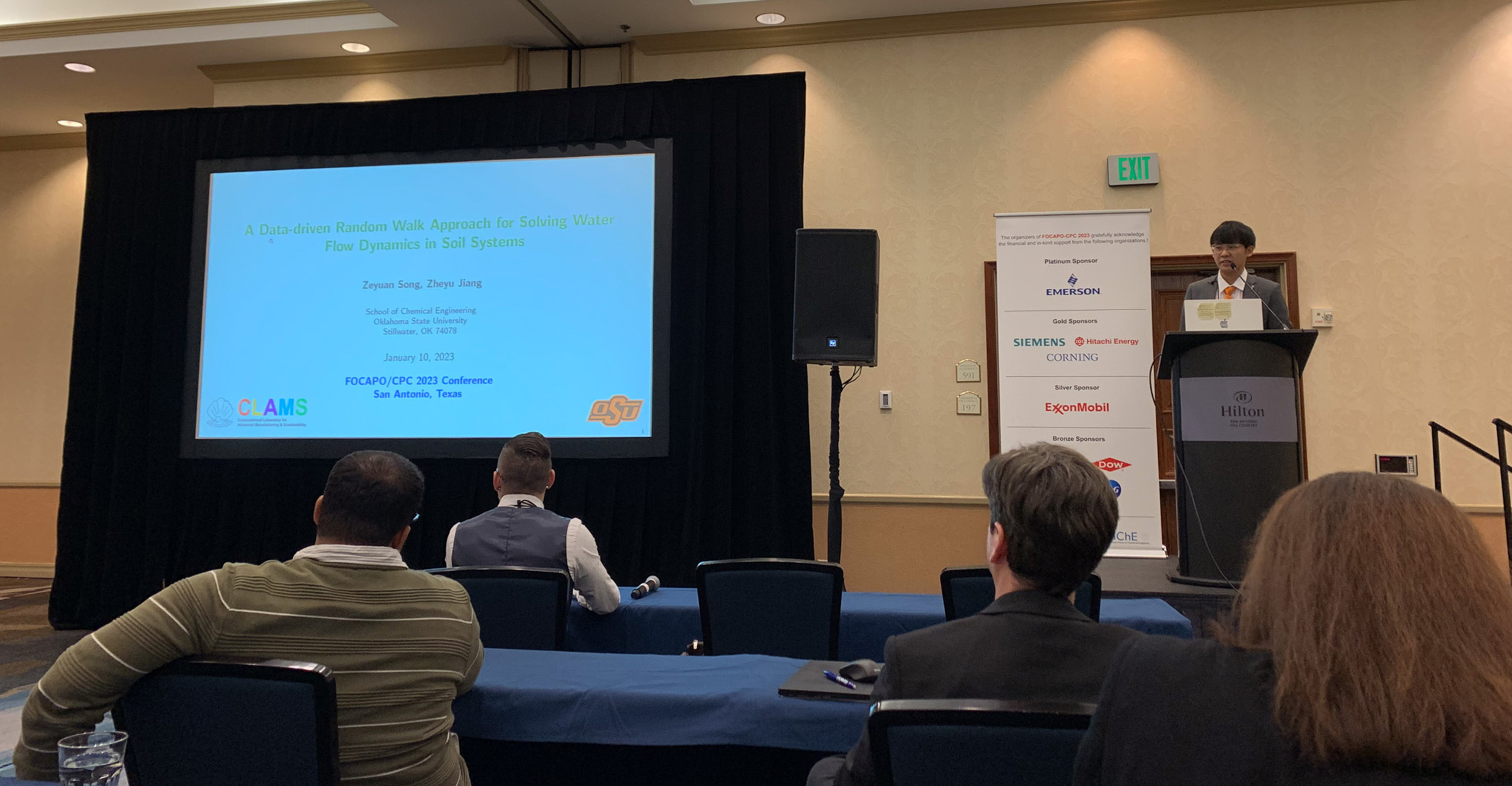
Dr. Zheyu Jiang, assistant professor in CHE, along with Zeyuan Song, a graduate research assistant on his team, started looking at this problem in 2022 and recently published a paper in Computers and Geotechnics on their newly developed mathematical method for quantifying moisture levels inside the soil.
“We are very excited about this publication because, first the journal is regarded as one of the top journals in civil/environmental engineering and geotechnics; and second, for chemical engineers, being able to publish our work in a top journal in another domain shows that our work is truly interdisciplinary,” Jiang said.
Their innovative approach, titled Message Passing Finite Volume Method, is an improved numerical technique to calculate soil moisture by solving the Richards equation. This highly nonlinear partial differential equation can model irrigation, precipitation, evapotranspiration, runoff and drainage dynamics across different types of vegetation, weather, soil and terrain. But the complexity of Richards equation also poses great computational challenges such as slow convergence and low accuracy.

Using breakthroughs with AI and deep learning, researchers can include physical soil characteristics into a neural network. Physics-informed neural networks have become popular tools but also require high computing needs.
Hybrid methods, which combine deep learning with discretization methods, enhance the accuracy and stability of numerical algorithms, but the variables involved do not represent any physical meaning and do not factor in water conservation laws.
The team’s innovative approach to overcoming these limitations integrate the latest AI and machine learning techniques with classical numerical discretization techniques to solve the Richards equation. Specifically, the team implements an encoder-decoder network architecture and a message passing mechanism to significantly improve the convergence and accuracy of finite-volume method discretization method.
“To account for the numerical errors observed during actual implementation due to computational constraints and realistic simulation settings, we introduce a data-driven approach to first learn the forward and inverse maps between the solutions using two neural networks, followed by integrating the trained neural networks with the numerical scheme via the message passing mechanism to achieve synergistic improvement in solution quality,” Jiang said.
“Furthermore, we also implement effective ways to perform data augmentation to facilitate neural network training using only a small number of low-fidelity reference solutions as training set. Overall, these innovative techniques work seamlessly to improve the convergence and accuracy of our algorithm in solving the Richards equation.”
Compared to standard numerical solvers, this new algorithm also better preserves the mass balance and conservation laws while not requiring as much computing power as other solvers.
This innovative approach will revolutionize the way farmers estimating real-time soil moisture distribution in their fields. This will give farmers a clearer picture of where, when and how much water is needed to irrigate crops.
“We envision that our algorithm to be a generalizable computational framework for modeling a wide range of geotechnical applications, including fractional diffusion of water in fractal soils, saturated-unsaturated seepage, in-field monitoring of soil suction profiles, transport in chemically reactive porous media, and so on,” Jiang said.
This research is just one example of CEAT making a real-world impact. By providing farmers with software tools to improve water use efficiency, Jiang’s team is determined to provide implementable smart farming solutions to problems in digital and sustainable agriculture, which will have long-lasting impacts to the entire nation and globe.