

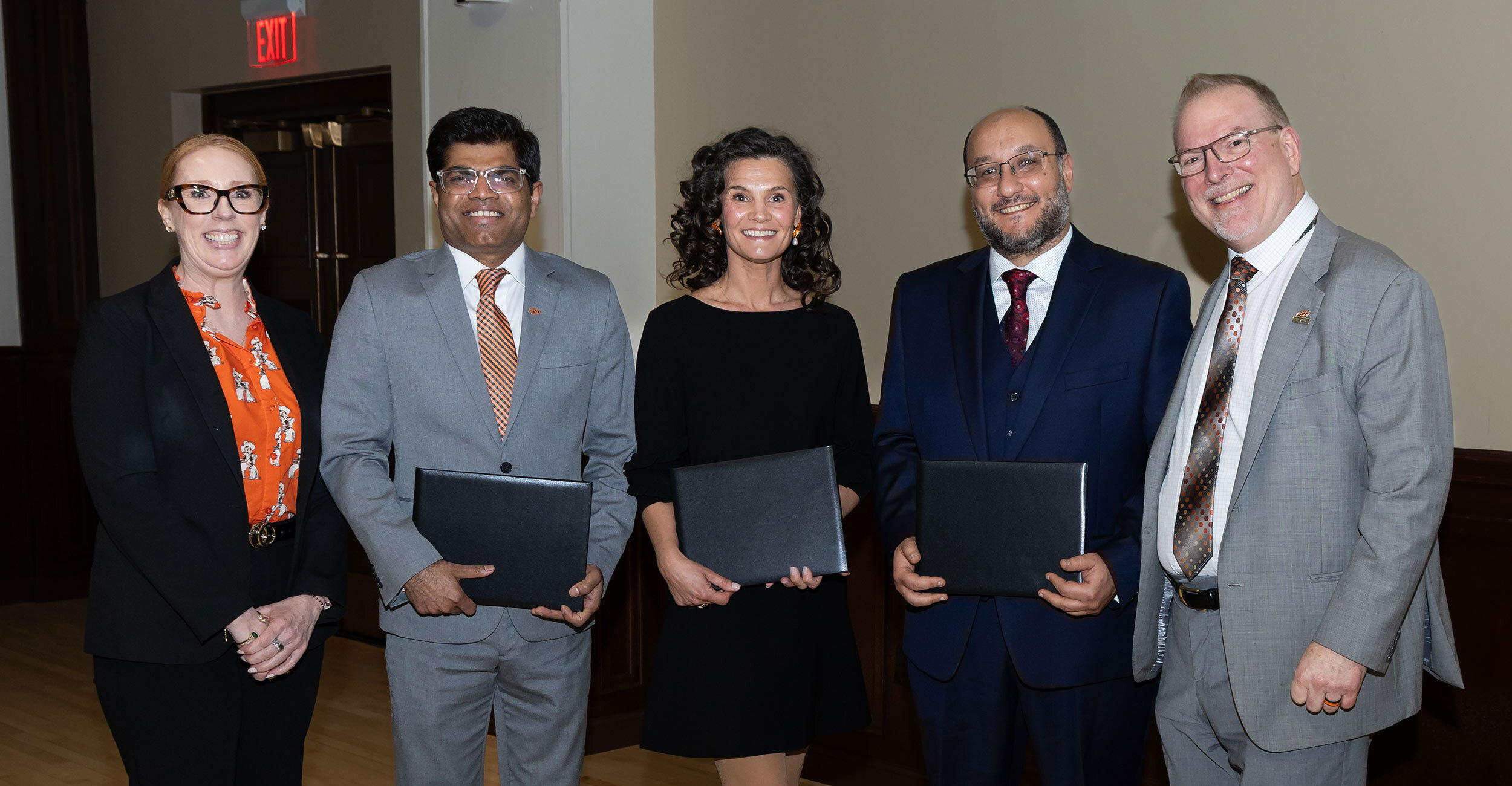
OSU recognizes President’s Fellows Faculty Research Award honorees
Tuesday, March 24, 2026
Media Contact: Sydney Trainor | Communications and Media Relations Specialist | 405-744-9782 | sydney.trainor@okstate.edu
Oklahoma State University researchers who are advancing innovative work across disciplines were named recipients of the university’s 2026 President’s Fellows Faculty Research Award.
Drs. Rudra Channappanavar, Jeanine Porck and Mohamed Soliman were recognized during the Annual Researchers Reception on Tuesday in the Student Union Ballroom.
Facilitated by OSU President Jim Hess and the President’s Fellows Organization, the program provides a one-time $20,000 grant to support faculty research projects. Award recipients will share updates with the President’s Fellows Organization through 2027.
“These grants are funded by donors to the university who then decide to give the president funds that can be used for whatever the president believes is of the highest importance and greatest need,” OSU Vice President for Research Kenneth Sewell said. “They are also a powerful reflection of our land-grant mission in action — supporting research that takes on real-world challenges and delivers meaningful impact for the people and communities we serve.”
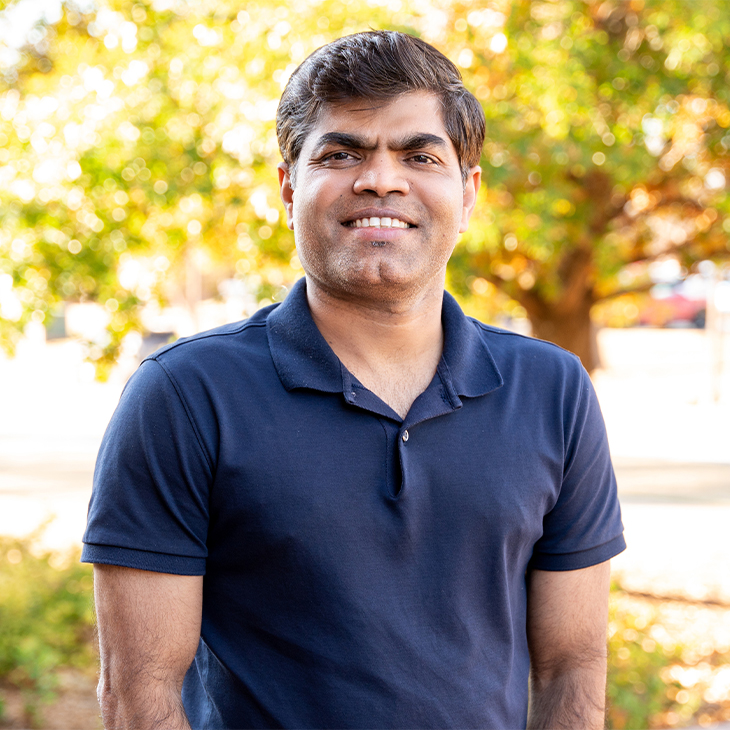
Advancing treatments for severe viral infections
Channappanavar, associate professor in the Department of Veterinary Pathobiology in the College of Veterinary Medicine, received the award for his project — Immuno-protective effects of GLP-1 receptor agonists in respiratory virus infection.
“Receiving the President’s Fellows Research Award is truly an honor,” Channappanavar said. “It reflects strong institutional support for the direction and impact of our research program and recognizes the hard work of our students, collaborators and colleagues. Advancing innovative basic and preclinical research to address critical challenges in infectious disease biology is central to our mission.”
Emerging and re-emerging viral infections remain a major global health concern. Current treatments, including corticosteroids, often provide limited benefit because they suppress both harmful inflammation and the body’s antiviral defenses. Channappanavar’s research focuses on identifying therapies that restore immune balance without compromising the body’s ability to fight infection.
His work centers on glucagon-like peptide-1 (GLP-1) receptor agonists — FDA-approved drugs widely used to treat diabetes and obesity. The project will further explore the molecular and immunological mechanisms behind this response, with the goal of establishing a new, translatable strategy to reduce virus-induced immune damage and improve outcomes in severe respiratory disease.

Improving workplace decision-making and health
Porck, associate professor and William S. Spears Chair in the Department of Management in the Spears School of Business, was recognized for her project — Enhancing Managerial Decision-Making and Workplace Health Through Cutting-Edge Wearable Technology.
“With the award, we can actually do this next study, which is very exciting,” Porck said. “That’s not just exciting for me. It is exciting because we expect groundbreaking findings. It is exciting because multiple Ph.D. students are involved and actually get to do this cutting-edge research. In addition to that, it’s exciting because we think the practical implications from this matter. They matter to managers, to organizations, and I hope we can even teach them to our students here at Spears.”
Her research tackles a persistent workplace challenge: why nearly half of managers fail to act on valuable employee input. Using insights from circadian biology, the study examines how timing, sleep patterns and stress levels influence decision-making.
The project will use wearable technology — specifically Oura Ring devices — to measure managers’ biological rhythms, sleep and physiological stress in real time. By identifying the “right time for input,” the research aims to improve decision quality while reducing workplace stress for both managers and employees.
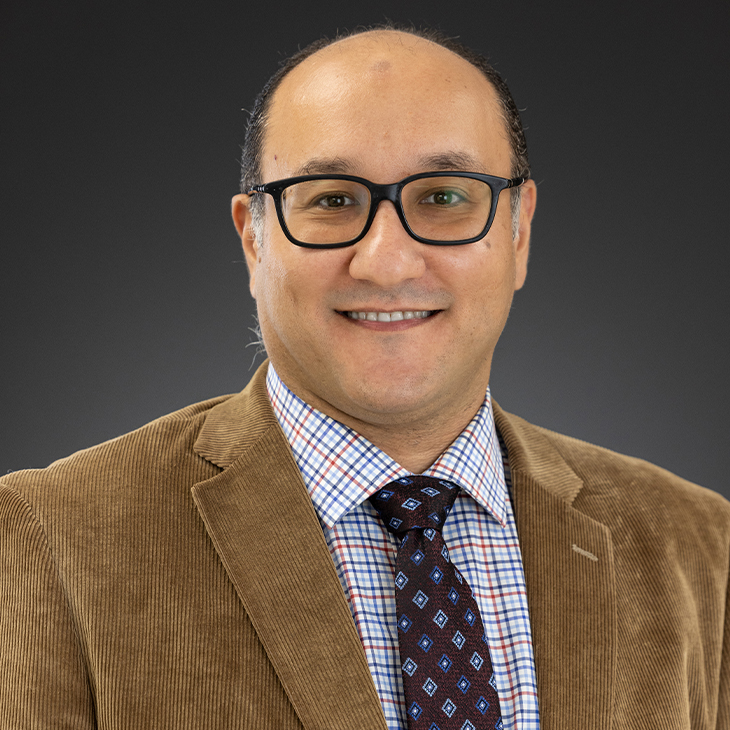
Exploring safer, more efficient construction methods
Soliman, associate professor and Decker Dawson Chair of Civil Engineering in the College of Engineering, Architecture and Technology, received the award for his project — Toward Robotic Construction of Steel Structures: A Scaled Testbed for Automated Assembly and Multi-Robot Coordination.
“This is a highly prestigious award, and I am truly honored by the trust and confidence placed in me by CEAT and OSU,” Soliman said. “It also crowns the years of planning and provides the momentum needed to advance our work in construction automation.”
Soliman’s research addresses one of the most hazardous and labor-intensive phases of construction: the erection of steel structures such as bridges, buildings and industrial facilities.
This phase is not only time-consuming but also ranks among the most dangerous occupations in the United States, exposing workers to significant risks during elevated welding and bolting operations.
The project aims to develop a foundational platform for robotic steel construction by demonstrating the feasibility of automated assembly and multi-robot coordination. Researchers will build a scaled testbed at the Bert Cooper Engineering Laboratory to simulate real-world construction scenarios.