


OSU history professor teaches American studies in Vietnam
Wednesday, February 18, 2026
Media Contact: Oklahoma State University | Department of Brand Management | 405-744-6260 | news@okstate.edu
When Dr. John Kinder, professor of history and American studies at Oklahoma State University, traveled to Hanoi, Vietnam, this past December, he wasn’t just delivering a guest lecture.
He was participating in a longer-term project: the incorporation of American studies into university curricula in the Southeast Asian nation, which shares a complex past with the United States.
"Educational ties between Vietnam and the U.S. are absolutely critical for both nations moving forward," said Dr. Randy Kluver, associate provost and dean of OSU-Global, whose office helped organize Kinder's involvement.
"As Vietnam’s regional relevance has grown, it is a tremendous benefit for U.S. institutions to have strong ties with Vietnamese counterparts.”
The backdrop for Kinder’s visit is a significant milestone in international diplomacy: the upcoming 30th anniversary of the normalization of relations between the U.S. and the Socialist Republic of Vietnam. Following the end of the Vietnam War and the capture of Saigon in 1975, the U.S. imposed a trade embargo and severed diplomatic ties for decades. It wasn't until 1995 that relations were reestablished.
Today, that relationship has evolved into a strategic partnership, with academic exchange serving as a vital pillar of mutual understanding.
"The U.S. Embassy-sponsored American studies conference hosted by Vietnam National University of Social Sciences and Humanities kicked off a year of planned activities in 2026, celebrating the 250th anniversary of the Declaration of Independence and strengthening U.S.-Vietnam relations," said an embassy spokesperson. "As Vietnam trains its next generation of leaders, this initiative enables a safer, stronger, and more prosperous future for both our countries by leveraging the excellence of U.S. higher education."
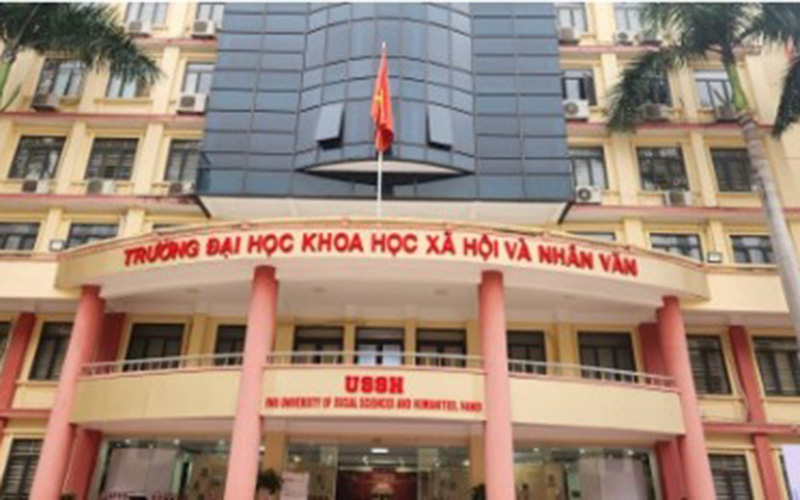
A Curriculum for the 21st Century
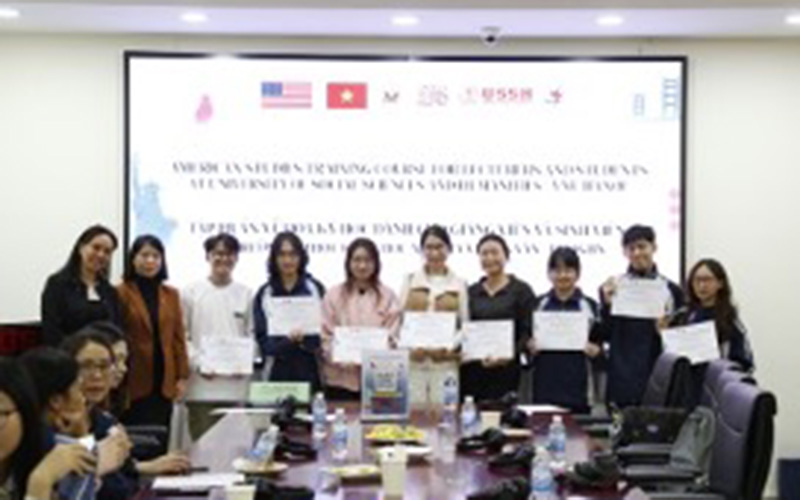
Kinder was invited alongside Professor Philip Habel (University of Alabama) and Professor Tatishe Nteta (University of Massachusetts) to participate in a conference organized by the U.S. Embassy and hosted by the Vietnam National University of Social Sciences and Humanities.
The primary mission? Working with Vietnamese scholars to revamp and build new curricula for American studies, specifically so that American culture and history are taught in a 21st-century context. Kinder came away highly impressed with his peers in Vietnam.
"For many of these instructors, the challenge is immense," Kinder said. "In some cases, they are being asked to cover all of American history, politics and culture in a single semester, and they often lack access to the scholarly resources that we take for granted."
Iris Trâm Ðinh, an instructor at VNUSSH, said working with American scholars such as Kinder was deeply valuable and much appreciated by Vietnamese educators.
"The exchange highlighted the importance of contextualizing American culture and history to foster critical thinking,” Ðinh said. “His discussion of the ‘melting pot’ versus ‘salad bowl,’ for example, helped clarify how American individualism intersects with cultural differences."
For Kinder, stepping into the VNU classroom was a striking experience for reasons other than its design. Unlike the sprawling green lawns of a traditional American land-grant university, VNU is woven into the urban fabric of Hanoi.
"It’s smack in the middle of the city," Kinder said. "You can see apartments and hanging laundry just above the roof of the main building. Much of it is made of concrete to withstand the monsoons. But once inside, I felt right at home."
Teaching the Everyday
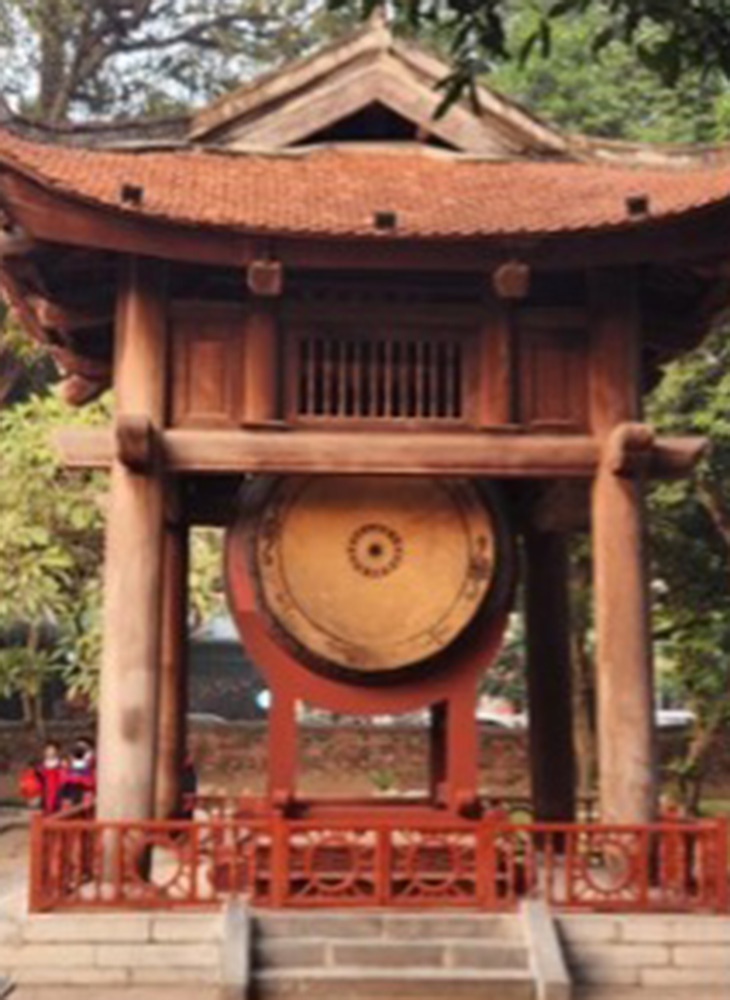
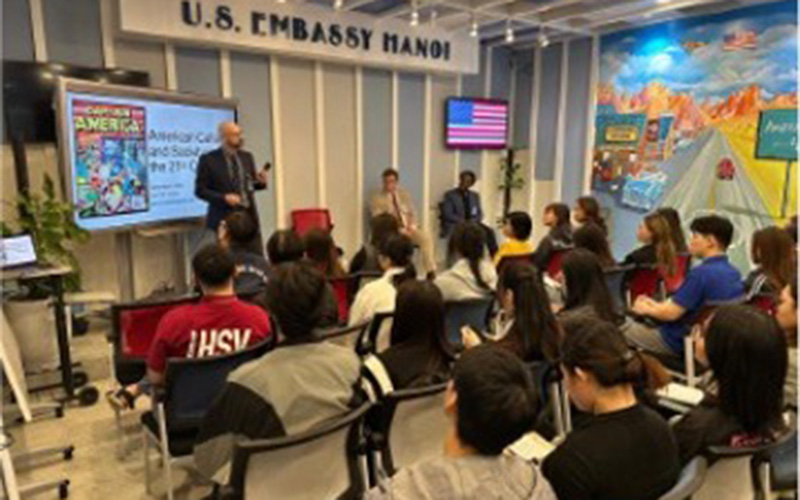
Kinder gave two lectures during his time at VNU in Hanoi — one for American studies teachers from across Vietnam, and the other for students interested in American history, foreign policy and culture.
In his latter lecture, "American Culture and Society in the 21st Century," Kinder emphasized a core tenet of American studies: that the most profound insights often come from the "everyday."
He opened his talk by remarking on the sea of motorcycles he encountered on his way from the airport to his hotel — more than he had seen in his entire life. He then contrasted this with the ubiquity of the Ford F-150 pickup truck in the U.S.
"You can learn a lot about a country by thinking about how people get around," Kinder said he told his audience.
Attitudes toward public versus private space, urban development, climate change and more can be detected in seemingly mundane details, such as daily transport.
"I wanted to emphasize that differences between Vietnam and the U.S. can be seen in motorbikes and half-ton pickup trucks as much as in politics or ideology," Kinder said.
For the VNU faculty of international studies who participated in the sessions, the experience was invaluable.
"The collaboration highlighted the importance of approaching American Studies as a dynamic, evolving, and multidimensional field," Dr. Lena Le said. "While our students remain Vietnamese, they are young people of a new era — more globally connected, more familiar with the United States, and sharing the same historical moment as Americans themselves.
“This makes it increasingly important for teaching to shift from merely synthesizing knowledge to guiding discussion, provoking reflection and opening up broader perspectives."
Shared Challenges in a Digital Age
Despite the geographic distance and cultural distinctions, Kinder was struck by the "universality" of the modern academic experience.
“During a workshop on classroom challenges, we broke into small groups to talk about the 'problems' in our classrooms," Kinder said. "The answers were strikingly familiar: the impact of AI on writing, the struggle to get students to engage with assigned texts, and the growing anxiety students feel about the job market after graduation."
Vietnamese professors, in short, are fighting the same battles as those at OSU.
"It reinforced my belief that, as professors, what divides us is far less important than the things we have in common," Kinder said.
Coming Home
From lecturing at VNU and at the U.S. Embassy to navigating the streets of Hanoi on the back of a motorcycle taxi, Kinder recognizes that the experience had a profound effect.
During his lecture on "American Culture and Society in the 21st Century," Kinder recalled how one student challenged the very core of American individualism, asking if a society that allows celebrities to mock its president openly can truly move forward together on the 21st century’s most urgent problems.
"I answered that freedom of speech is a hallmark of our culture," Kinder said. "But also that the student was getting at a larger point. How on Earth are we ever going to address complicated issues like national security, immigration, climate change and poverty if we can’t even agree whether COVID was a ‘hoax’ or whether the news is fake?”
Kinder returned from Hanoi with a renewed commitment to international perspectives.
"It’s important to understand how we think about ourselves, but it’s just as important to help our own students understand how the United States is viewed from abroad," he said.
Story By: Dr. Sarah Griswold | sarah.griswold@okstate.edu