


Spears Business assistant professor Du illustrates how political geography shapes economic resource allocation
Monday, December 15, 2025
Media Contact: Hallie Hart | Communications Coordinator | 405-744-1050 | hallie.hart@okstate.edu
New policies often have unforeseen consequences. This can be true in workplaces, in cities and even across countries, but it’s difficult for researchers to measure the magnitude of these repercussions.
Dr. Rui Du is rising to the challenge, using data from one of the world’s most populous cities to illustrate a government regulation’s ripple effect on the restaurant industry. The assistant professor in Oklahoma State University’s Spears School of Business recently published his findings in the top-tier Journal of Urban Economics.
Du’s paper, “Political Geography and the Spatial Allocation of Economic Activity: Evidence from China’s Anti-Corruption Campaign,” explores the economic landscape around Beijing’s government centers, showing how political forces shape spatial economics.
Simply put, a change in one sector can drastically impact an unrelated sector. Du said this broad implication connects to current events in the United States, where the real estate industry is grappling with office building vacancies and income instability because of numerous federal government contract and lease cancellations.
“Political geography matters,” Du said. “Although our paper specifically looks at one sector and one specific policy in China, it is related to a lot of political forces and how they shape economic distributions in many other different countries.”
Du collaborated with Drs. Filipe Campante from Johns Hopkins University, Weizeng Sun from Nanjing Audit University in China, Jianghao Wang from the Chinese Academy of Sciences and Siqi Zheng from Massachusetts Institute of Technology on this publication.
In OSU’s Department of Economics, Du thrives at the intersection of economics and geography. Many of his research questions grew out of his early experiences in China, where he was fascinated with the daily hustle and bustle of city life.
“All of these resources — like housing, transportation, infrastructure and jobs — are allocated in a certain way within the cities,” Du said. “What does it mean when they’re allocated in a certain way? How will that impact our lives and our productivity? That triggers my interest in this specific area.”
When studying urban economics, it makes sense to look at Beijing, a metropolis where political and market forces collide. China’s bustling capital is home to about 22 million people.
In his recent paper, Du focused on the impact of China’s Eight-Point Regulation, enacted in December 2012 to address public officials’ extravagant spending habits. Du and his co-authors wrote that the regulation prohibits “luxury banquets” and “grand receptions for officials’ visits” while stating “leaders must practice thrift and strictly follow relevant regulations on accommodation and cars.”
While this policy targeted bureaucratic corruption, it came with a significant impact on the restaurant industry.
Du and his co-authors geocoded 120 Beijing government bureaus and gathered restaurants’ data from Dianping, a Chinese platform similar to Yelp. Their findings indicate restaurants within 1.5 kilometers of government centers experienced a statistically significant drop in customer traffic and average expenditure per customer after the Eight-Point Regulation took hold. Meanwhile, restaurants farther from the government centers did not.
The researchers found these losses equate to about 3 billion renminbi (RMB) in China, or about 488 million U.S. dollars.
Although the effect was especially pronounced for upscale restaurants, dining spots labeled as “lower-end” also experienced a decline. Du suggested the upscale restaurants might have adapted to appeal to the average customer, therefore directly competing with the less extravagant dining spots.
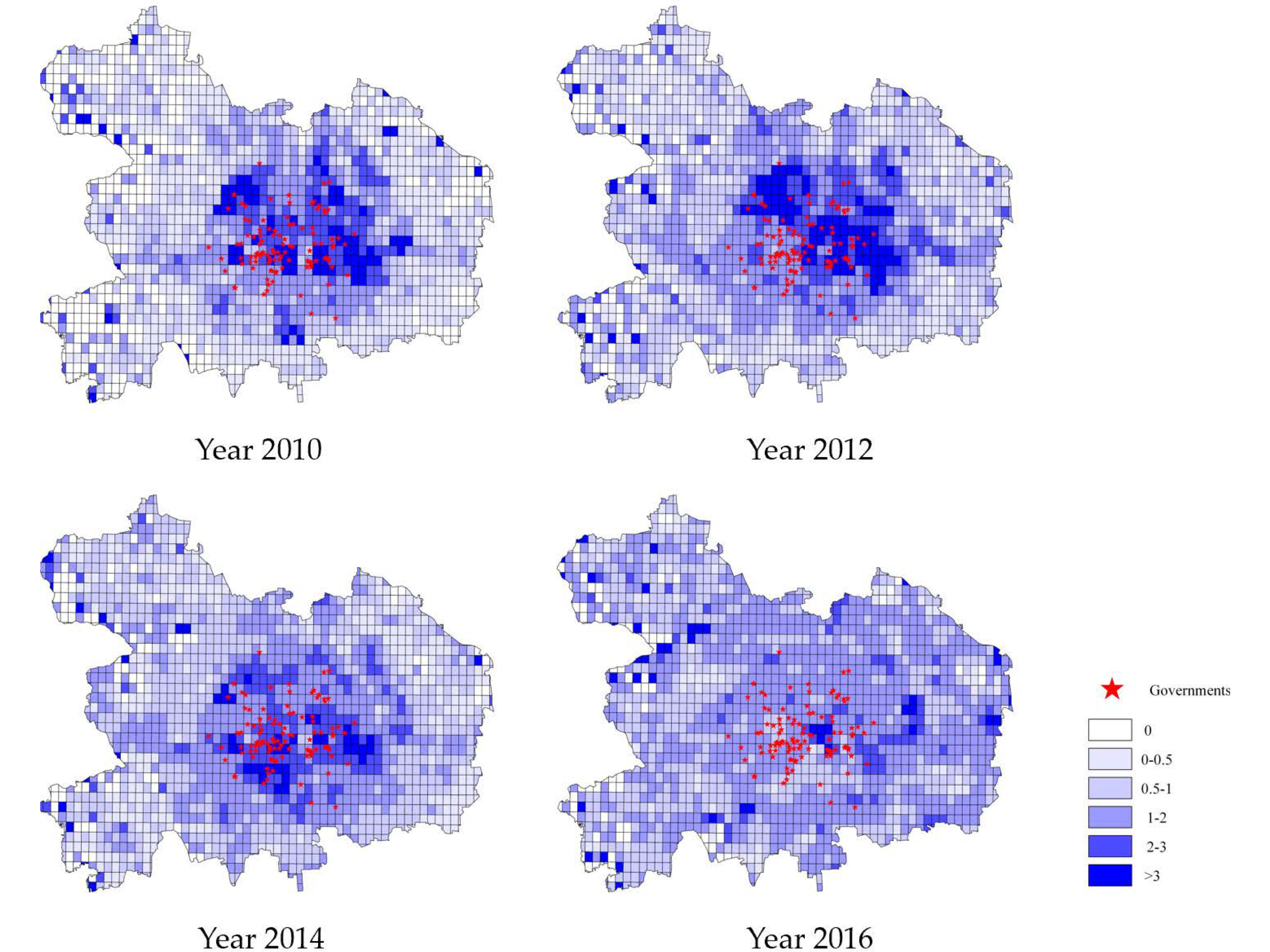
Over time, the impact wasn’t just economic — it was geographic.
Du observed striking changes in the physical distribution of Beijing’s restaurants, documented in his article’s maps of Beijing’s six inner districts from 2010-16. While red stars represent government offices, deeper blue shading represents higher restaurant density compared to the citywide average.
In 2010, restaurants were clustered around government centers. By 2016, restaurants had scattered across the city with significant drops in relative density near government offices.
“That’s the adaptation from the market side,” Du said. “The previous political geography evaporates. How do markets react? We can see the result is that they shift towards more market-oriented allocations. That’s a more natural distribution of the economy.”
Du’s insights raise questions about how political geography shapes the spatial allocation of economic resources, often distorting market efficiency. Furthermore, they shed light on how industries around the world adapt to turbulent political landscapes.
In the United States, for example, how have terminated contracts, a deluge of government layoffs and the recent government shutdown affected unrelated businesses? Does the impact vary depending on a business’ proximity to a government center?
The long-term effects aren’t yet measurable, and economists must analyze patterns over multiple years. Although quantifying the ripple effects of policies is not easy, Du said the rise of big data and advanced data analytics tools makes it possible. He encourages more research in his field to paint a full picture of factors that influence resource allocation.
“Allocation of economic resources is the core of economic study,” Du said. “That gives us a sense of how we actually can improve our standard of living in the future.”
Du and his co-authors didn’t take a stance on the Eight-Point Regulation — rather than conducting a cost-benefit analysis, they focused on a specific consequence to illustrate a larger phenomenon. Their findings have relevance to policymakers everywhere, from local to state to federal levels worldwide.
“The one message we can learn here, over and over from different research papers, is that whenever we design a policy, it is imprudent to focus on just the narrow scope of our policy targets,” Du said. “We’re going to have to have a more general equilibrium mindset when we design these policies. How does this particular policy affect economic agency, including population, jobs and productivity, in those seemingly unrelated sectors?”
Visit the website to learn more about Spears Business research and explore faculty areas of expertise.