

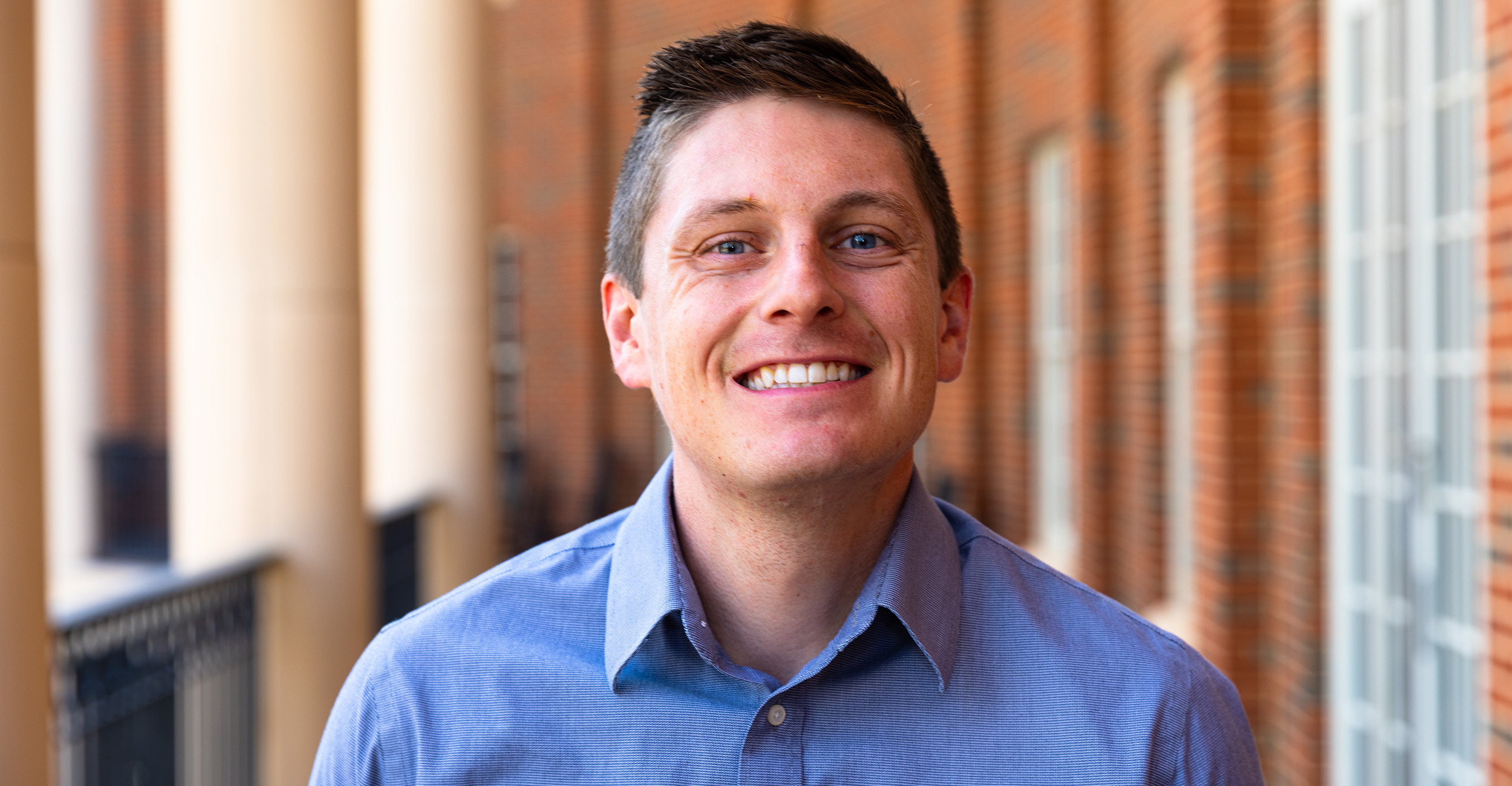
New OSU assistant professor Baucum amplifies MSIS department’s research impact
Monday, December 1, 2025
Media Contact: Hallie Hart | Communications Coordinator | 405-744-1050 | hallie.hart@okstate.edu
Dr. Matt Baucum’s research fits in because it stands out.
Oklahoma State University’s Department of Management Science and Information Systems has built a tradition of contributing influential research to the field. Even before the department’s creation over 20 years ago, award-winning faculty members distinguished themselves as prolific scholars on a global scale.
In his first semester at the Spears School of Business, Baucum is doing the same. The assistant professor won two Best Paper awards after presenting at the 2025 Institute for Operations Research and the Management Sciences Annual Meeting in Atlanta.INFORMS is a prestigious professional association with nearly 12,000 members worldwide.
Baucum’s co-authored publication, "Reducing Overdose Deaths and Mitigating County Disparities: Optimal Allocation of Substance Use Treatment Centers," earned the Pierskalla Best Paper Award from the INFORMS Health Applications Society. He also co-authored “Supervised Clustered Interpretability: A Novel Method Towards Transparent AI with Social Good Implications,” which won the INFORMS Data Mining Section Best Paper Award.
Baucum, who previously served as an assistant professor at Colorado State University and Florida State University, applies data analytics to social welfare and public health issues. This fall at OSU, Baucum has quickly realized how his research philosophy aligns with the MSIS department’s overarching mission.
“Real-world impact and doing high-quality work go hand in hand,” Baucum said. “That is something I’ve really come to appreciate with this group, because this group does such a good job of keeping those two goals in mind. Do really rigorous work that will publish well and improve the department’s stature, but then when you do that, your work gets more visibility and you have more chances for it to impact practice.”
Baucum has joined one of the world’s top departments for research productivity in his discipline. From 2014-23, OSU’s MSIS faculty produced the second-highest number of journal articles in Decision Support Systems, trailing only the City University of Hong Kong. Regents Professor Dr. Dursun Delen was the most prolific individual researcher during that time frame, authoring or co-authoring 18 publications.
From 2020-24, OSU faculty produced 234 business analytics papers, or 16.71 per faculty member, for the fifth-best scholarly output rate among 107 schools in the University of Iowa’s Business Analytics Research Rankings.
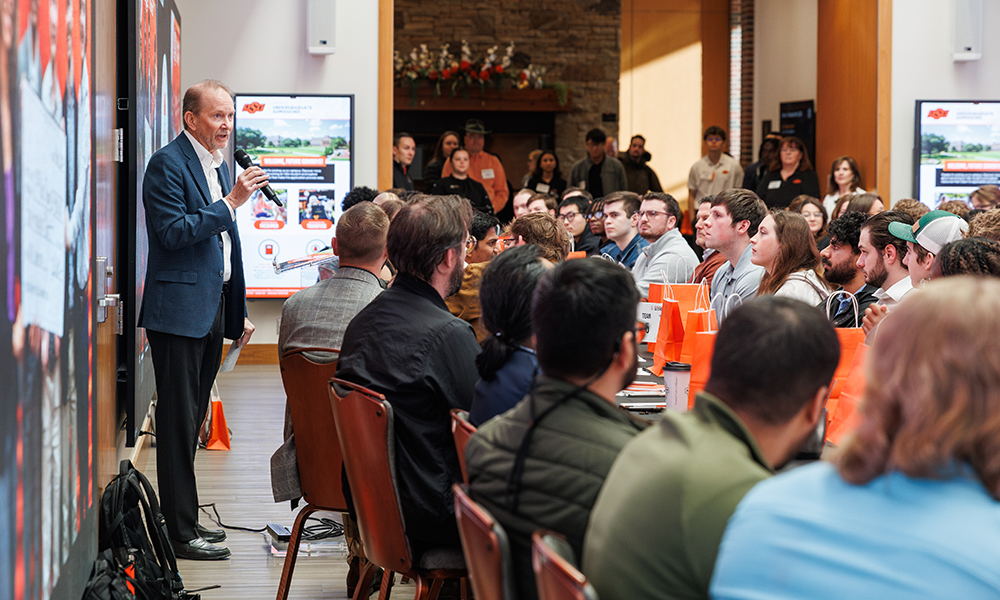
Another recent bibliometric study focused on artificial intelligence in accounting, identifying MSIS department head Dr. Rick Wilson and Regents Professor Dr. Ramesh Sharda as the authors of the field’s most-cited article. Sharda, an INFORMS Fellow, spent more than a decade as the Spears Business vice dean for graduate programs and research, strengthening the entire school’s research emphasis.
The MSIS department combines academic prestige with practical problem-solving methods. Baucum, who has a master’s degree in quantitative psychology from the University of Southern California and a Ph.D. in industrial engineering from the University of Tennessee, shares his department’s focus on harnessing data to improve lives.
“We are so proud of Matt and his award-winning research presented at INFORMS,” Wilson said. “Our department is blessed with many great scholars doing truly impactful research. Best of all, these same faculty — like Matt — bring these data science/AI research accomplishments into the classroom, where they excel in helping develop our students for the future AI-enabled workforce. Our department truly embodies the land-grant mission of OSU.”
One of Baucum’s award-winning papers uses data to address substance use disorder, which affected 48.5 million people in the United States aged 12 and older in 2023, according to the National Survey on Drug Use and Health.
Baucum aims to shed the stigma around SUD. His paper cites Cleveland Clinic’s definition of SUD as “a mental health condition,” and Baucum approaches the disorder from a health care perspective.
“There are a lot of ways in which having sufficient access to substance use care is complicated by stigmatization,” Baucum said. “That shouldn’t stop us from trying to find better strategies and solutions to getting people the care that they need. We know from past research, well before mine, that having good access to treatment really does make a difference.”
Baucum collaborated with Dr. Matt Harris and Dr. Lawrence Kessler from the University of Tennessee and Dr. Guanyi Lu from Florida State University on this groundbreaking paper, which appears in Manufacturing & Service Operations Management, an INFORMS journal. The researchers analyzed data to optimize the distribution of SUD treatment centers across United States counties.
The team considered fairness and effectiveness, reviewing U.S. overdose death statistics to identify locations where new treatment centers could make a significant difference. This required a balance of equality, or even distribution of treatment centers based on population, as well as equity, or need-based distribution.
No two states are alike, and the best strategy for each state depends on how many counties it has and how its population is distributed. Baucum noted the importance of access for both rural areas and highly populated cities.
“We thought that was interesting because so much of the discourse is around not having access in rural areas, which is so true, but we don’t talk as much about our cities not having enough access,” Baucum said. “When you start looking at things on a per capita basis, things really change. A city might have 30 treatment centers, which doesn’t sound like a problem — but if that city has 2 million people, you might have a really hard time getting into a treatment center, maybe even more so than in a rural area with a single treatment center.”
Baucum continues to study topics related to SUD treatment, analyzing specific services at treatment centers and exploring how telehealth factors into resource optimization. He has also used data analytics to study other medical diagnoses, including Parkinson’s disease.
While some of his MSIS colleagues study public health, others impact vastly different areas. Faculty apply data analytics to societal challenges that include improving cybersecurity, combating misinformation during natural disasters and developing algorithms to detect disease risks. Baucum said his department’s eclectic nature is one reason he enjoys working at OSU.
“No matter what problem I’m working on, I can find someone in the department who has expertise in it,” Baucum said. “That’s a huge strength.”
Visit the website to learn more about OSU’s MSIS department, meet the faculty and explore academic programs.