


Two CHE student design teams finish first in AIChE contest
Thursday, December 4, 2025
Media Contact: Tanner Holubar | Communications Specialist | 405-744-2065 | tanner.holubar@okstate.edu
Students in the School of Chemical Engineering in the College of Engineering, Architecture and Technology at Oklahoma State University continue to showcase high-level success on the national stage at the AIChE Annual Student Conference in Boston on Nov. 2, 2025.
A team of Brandi Head, Kenna Lam, Nikole Salas and Blakely Smith, all 2025 graduates, combined their talents and crafted a solution to the problem presented.
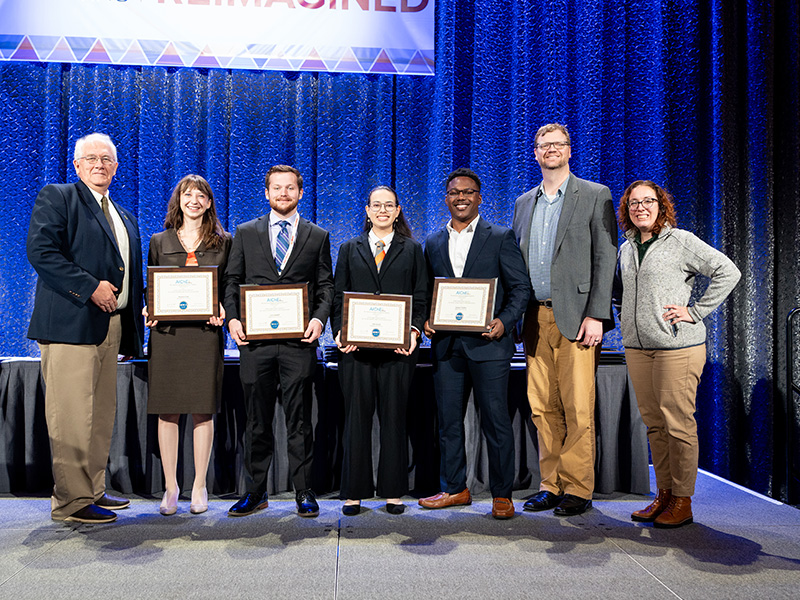
The team was also one of two groups to win the Process Safety Division Award along with the team of Cory Campbell, Margaret Cook, Tylee Kareck and Keshawn Wallace, wrapping up a fantastic conference for CHE and CEAT.
Drs. Josh Ramsey and Clint Aichele oversaw the teams’ work through the challenge of designing a process to produce blue hydrogen, a fuel utilized for its low CO2 emissions. The team had 60 days to complete the design on their own, submitting a comprehensive design that was evaluated by a panel of academic professionals and practicing engineers.
“This award is a collective achievement for our entire school, as the project required the students to apply knowledge from all their courses,” Ramsey said. “Our strong history of success in this competition provides national recognition and external validation of the quality of our program."
Dr. Heather Fahlenkamp, CHE school head and professor, said the achievement was not possible without the support from the entire college. CHE students receive tremendous experiences in their core courses, especially their senior design capstone course, for the AIChE contest.
"Congratulations to Brandi Head, Kenna Lam, Nikole Salas, Blakely Smith, Cory Campbell, Margaret Cook, Tylee Kareck and Keshawn Wallace on your outstanding accomplishment,” Fahlenkamp said. “We know that our students are talented, but it’s nice to have outside confirmation from others, especially at the highest level.”
Consecutive years of success
This is the second year in a row that a CHE team has finished first in the Student Design Contest. In previous competitions, students have been tasked with addressing vaccine production, plastic recycling and converting natural gas to gasoline.
The students received their assignment to produce blue hydrogen during their final semester, spending late nights working to craft a solution. They had been assigned a similar task on a smaller scale in their senior design class, and the larger project gave them experience working on a solution to a real-world problem.
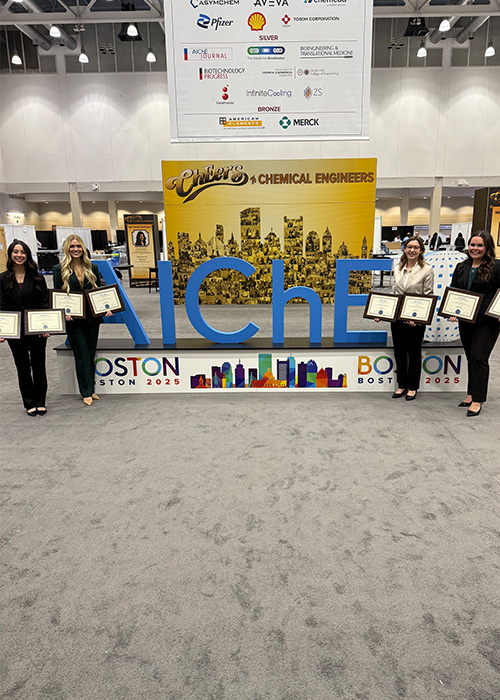
Smith said it was incredibly rewarding to see the team’s hard work pay off, especially in a nationally recognized competition. The team relied on each member’s individual strengths, coming together to form a cohesive unit that resulted in a design the team was proud of.
“Being part of a national winning team strengthened my confidence as an engineer,” Smith said. “Seeing our design progress from an initial concept to a complete, well-executed project proved to me that I can help contribute meaningfully to large-scale engineering work. That is a skill that will help me deliver quality work in my professional career.”
Salas said the team worked through the challenge of crafting their design to the specifications of what a company would need along with methods that are used in industry. By reading papers on current industrial practices and developing effective solutions, the team gathered data that helped them optimize their design.
“I am so grateful for my teammates,” Salas said. “We had so much fun working with each other, even when we felt stuck on the project, we still found silly reasons to laugh. I would also like to thank our instructors, Dr. Ramsey and Dr. Aichele, as well as the chemical engineering department. Without talented and passionate professors, we would not have accomplished this. Our degree program pushed us to not only to think hard, but to work hard. I believe that receiving an honor like this demonstrates faculty success just as much as the students.”
Students also benefited from professional development, as well as being able to showcase what CHE students are capable of on the national stage.
“This experience has already opened doors for me at work and has helped me expand my professional network,” Lam said. “I’m proud to represent Oklahoma State and show what our CHE program can really do.”
Head said the collaborative environment fostered by this successful team of students will allow them to embrace future challenges regardless of how daunting or complex the project may be.
“The experience of successfully completing the design project as a team and winning the competition has developed confidence in my abilities to overcome such significant challenges,” Head said. “Completing a project of this size and scope validates our education, training and preparation to launch us into our careers.”
Shining in safety
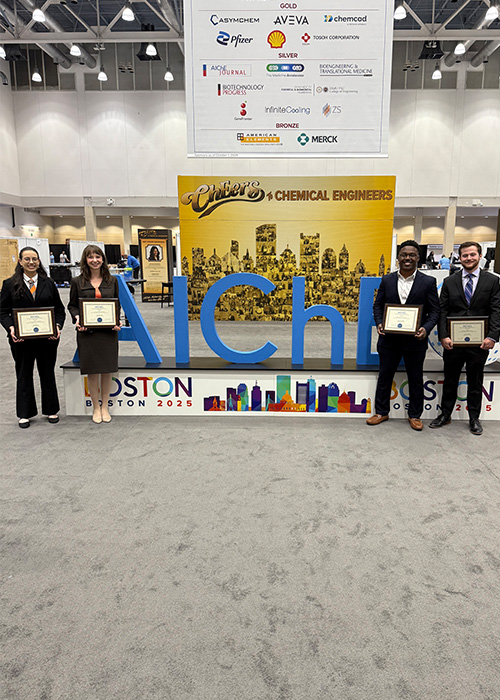
With two teams winning the Process Safety Division award, it is another area where CHE’s students stood taller than their peers. Teams were tasked with developing a model for a blue hydrogen production plant that incorporated carbon dioxide capture/storage as part of the conversion process of natural gas to hydrogen.
Their model needed to represent a plant that would be profitable, while sufficiently reducing carbon emissions and maintaining safety for both people and the environment.
“Chemical engineering is all about effective risk mitigation, and to do that we had to identify those hazards within our process,” Cook said. “Due to the production of blue hydrogen requiring high temperatures and pressures, we had to use materials that could withstand these conditions with the hydrogen embrittlement, as well as deal with the obvious hazard of operating with large volumes of flammable gases. To this end, we focused on developing an inherently safe system, including containment strategies, thoughtful control and safety systems, and the recommended plant location/basic layout.”
This is the type of research that can benefit students who are going into a variety of fields. Wallace is now in medical school at the OSU College of Osteopathic Medicine, and while he may not use his talents in energy production, he has still benefited from the problem-solving skills the team used to complete their task for AIChE.
“As a physician, I may not be setting up equations or structural designs for energy production, but I will inevitably have to incorporate the critical-thinking and problem-solving skills gained from this project,” Wallace said. “It will be my job to solve complex health problems for patients and do so in the safest, most efficient manner possible to improve their quality of life. Given that this award is specifically within the safety division, it is a great indicator of my ability to do just that.”
Kareck said this project aligns well with her goals to continue working in process safety. While she had some experience with safety measures and hydrogen production, the scale of the team’s design process was a great learning experience.
“While I currently intend to stay closer to academia than direct practice, I am grateful to have been given the opportunity to explore these concepts in an industrially relevant context,” Kareck said.