


Cowboy Combustion: Pistol Pete's Propulsion Posse pushes OSU propulsion to new heights
Wednesday, December 3, 2025
Media Contact: Tanner Holubar | Communications Specialist | 405-744-2065 | tanner.holubar@okstate.edu
Propulsion research at Oklahoma State University has the Cowboy spirit soaring to new heights.
That spirit reflects the traits that have come to define OSU students — whose ambition stretches past the horizon with a work ethic rooted in gritty integrity and a determination to innovate in unexplored areas.
The School of Mechanical and Aerospace Engineering in the College of Engineering, Architecture and Technology is a name that resonates in the jet propulsion industry. Under the direction of Dr. Kurt Rouser, who joined OSU in 2016 following 25 years in the Air Force, the MAE program has advanced jet propulsion research to the point where a new student organization was necessary.
Pistol Pete’s Propulsion Posse (P4), officially formed in September 2025, is an organization of dedicated students of all majors at OSU who are interested in jet propulsion. Graduate students who have studied under Rouser for several years are mentors in the group, while younger students are exposed to more hands-on opportunities than what was available previously.
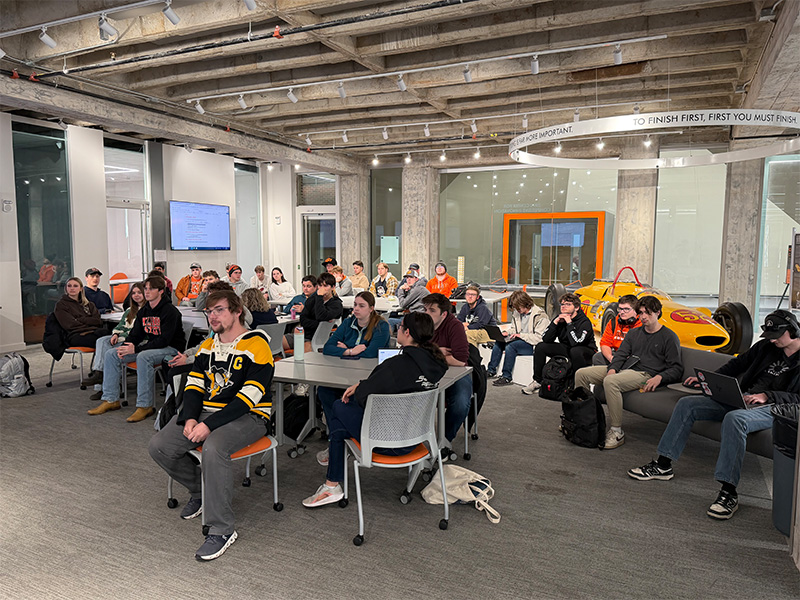
These two teams are combinations of students in a variety of disciplines uniting their expertise to tackle the design challenge for the Air Force sponsored Aerospace Propulsion Outreach Program competition. Whichever design is deemed the best will then be submitted as part of the APOP competition. The best design between the two teams will be tested for scoring at Tinker Air Force Base in spring 2026.
The OSU propulsion program has grown by leaps and bounds in recent years, now to the point where a new task will be undertaken for senior design projects in spring 2026, when students will completely design, fabricate and test an advanced manufactured micro-turbojet from scratch, for the first time.
At CEAT’s Richmond Hill Lab, students have the capability to assemble, dynamically balance and test the engines. Some of the parts require outsourcing for advanced manufacturing work, but students taking part will use experience they have gained through P4.
“We have this incredible talent that gets developed, and that talent pool will continue to grow with the students paying it forward as they help younger students become more familiar with propulsion,” Rouser said.
Interdisciplinary expansion
P4 already has enough members for two teams of 25-plus members from multiple graduating classes, majors, interests and backgrounds.
Brody Richardson, vice president of P4, said the challenge faced by the two teams in P4 is a big difference from what students have done in the past with one-year senior design projects.
The mixture of majors coming together allows opportunities to learn from others, use new perspectives to solve problems and develop new ideas and methods.
“Students who join P4 jump several years ahead of the typical learning curve,” Richardson said. “Instead of waiting until senior year to work on a real turbojet design–build–test project, freshmen, sophomores and juniors collaborate directly with seniors on a national competition project sponsored by the Air Force!
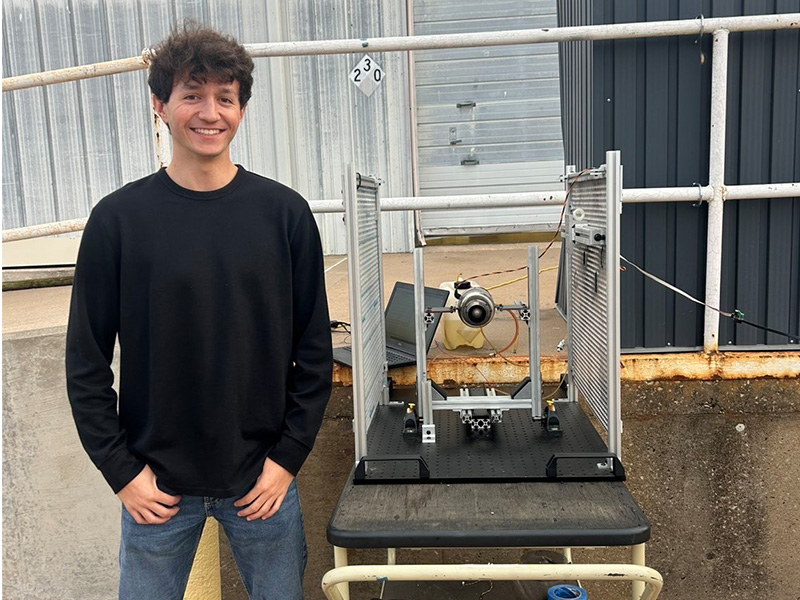
“They gain experience in design reviews, analysis, manufacturing, and testing, while also learning to communicate across subteams and class years. By the time they reach senior design, they’re not just ready for a capstone — they’re already operating like confident, experienced engineers.”
Bruce Lamoreaux, president of P4, said students are divided into different positions for engine work, as well as organizational work such as branding and marketing, fabrication and design, as well as outreach.
Lamoreaux’s interest in propulsion piqued after studying under Rouser, coming out of that experience knowing he wanted to be a propulsion engineer. He has worked as a teaching assistant for the same course, helping younger engineering students as they move through the program and take part in groups like P4.
“Since then, just getting involved in all this has given me a lot more skills to add to my resume and to my knowledge,” Lamoreaux said. “I’ve had more interest from aerospace companies as I reached out for the club. I’m also able to help teach my peers a lot of what I have gotten to learn myself.”
Expanding work with Oklahoma’s military installations
Part of the partnership with Tinker AFB has resulted in connections for students and engineers who have worked at the base.
Jared Henderson is a civilian engineer at Tinker who is a former student of Rouser’s. From what he has seen, OSU aerospace students receive opportunities that students in other universities in the region do not.
“Now that I’m in industry, I work with people from OU and other universities, and when I talk about what my senior design was and some of the projects I’m working on now, they don’t have anything anywhere near what we’re doing here,” Henderson said.
Alexandra Boyko, a graduate student who has working experience at Standard Aero, said her knowledge of jet engines was on par or ahead of what many of her peers knew.
“I feel like I can go into industry with more practical and conceptual knowledge after being in this program at OSU,” Boyko said.
Charles Daggett, a grad student in his sixth year working under Rouser, said while he has learned an exponential amount about propulsion, it is his ability to engineer a solution to a problem.
“My experiences in the industry so far have not been in the propulsion sector, but I’ve been able to take the process of problem solving to solve problems in the opportunities that I've had,” Dagget said.
Building up to P4
When Rouser started at OSU in 2016, the concept of students designing, building and testing a jet engine wasn’t a possibility. In 2018, Rouser had some students compete in the American Institute of Aeronautics and Astronautics engine design competition, which consisted of students presenting a paper design of a jet engine.
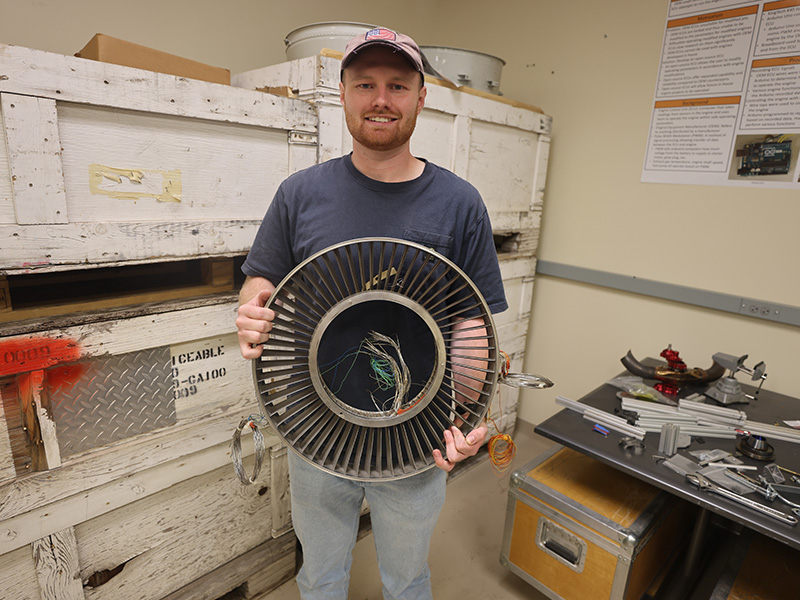
At that conference, a former student of Rouser’s during their time at the U.S. Air Force Academy recommended to Rouser that his students enter the APOP competition, an intercollegiate engine design competition where students work to meet requirements put forth by the competition committee.
The first group to compete in APOP consisted of five students whose challenge was to improve an engine’s weight-to-thrust ratio. The team won first place that year, coming up with a design that resulted in a 30% increase in the ratio.
Around this same time, enough students had joined Rouser’s research team that two teams were formed to both take on the APOP challenge, with the best of the two designs representing OSU in the competition.
Since then, students have tackled challenges such as thrust vectoring, reverse thrust, power generation and adding to an engine’s existing capabilities. More students, including those with rocketry and propeller interests, continued to join under his research umbrella within MAE.
Students continued to hone their skills and expand their knowledge as more research scholars started working under Rouser.
“Each year, it seems like we would end up with two teams. One team was aggressive, something that would require a lot of finesse but would get maximum scoring if it was successful,” Rouser said. “The other team would look at something and make sure it worked with a more brute force approach. And with the two types of teams, we would have something that would do well in the competition.”
In 2019, Rouser’s team moved to a lab space at Richmond Hills with more than 6,000 square feet. The number of students kept growing and so did their capabilities, with the rocketry students eventually forming a separate club from the turbo engine students.
While MAE students continued to hone their expertise in propulsion, students in electrical engineering and computer engineering became more involved as contracts were obtained with the Federal Aviation Administration and NASA.
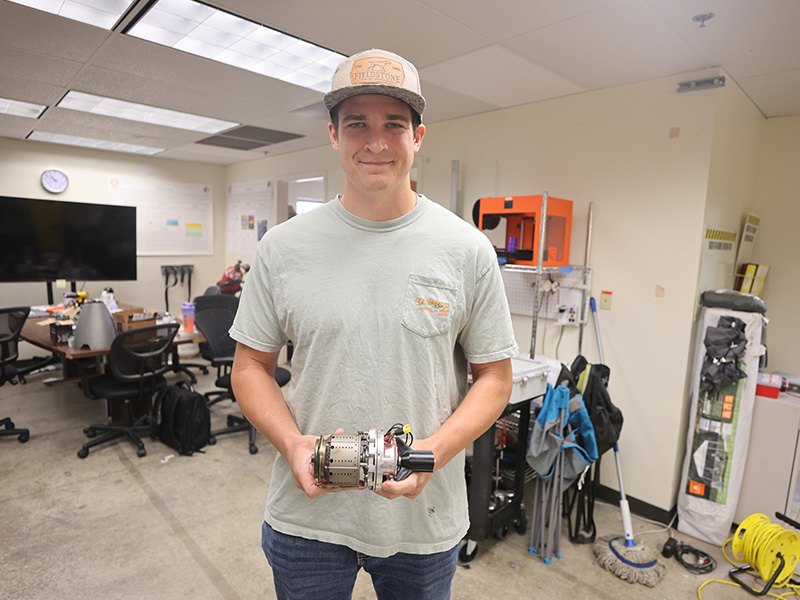
This allowed students to gain more experience with additive manufacturing, electrical engine components and engine ignition.
In the summer of 2024, students made their own engine control unit, and in summer of 2025, students built their first combustor taking available parts and adding them to their control engine to make a unique engine. This led to students once again producing one of the best designs on display at the APOP competition in spring 2025.
That semester was also the first time students were able to test their engines at Tinker Air Force Base, showing the expanded connection between students and Tinker engineers.
Micro turbojet research has also been expanded through partnerships with companies W9er and Valkyrie Systems Aerospace, working on projects meeting the specific needs of both companies.
These partnerships have also resulted in the purchase of a dynamic balancer, which students can use to test their engines and discover any defects earlier to be corrected earlier. Students can now use this dynamic balancer on their senior design projects for the first time in spring 2026.
Getting involved
Pistol Pete’s Propulsion Posse is open to any OSU students. For more information on how to get involved, reach out to Bruce Lamoreaux at bruce.lamoreaux@okstate.edu or Brody Richardson at brodyri@okstate.edu.