


Shen targets safer firefighting with advanced hydrogel technology
Friday, December 12, 2025
Media Contact: Desa James | Communications Coordinator | 405-744-2669 | desa.james@okstate.edu
What happens when water, the world’s most common firefighting agent, isn’t adequate? Dr. Ruiqing Shen with the College of Engineering, Architecture and Technology aims to provide the answer.
With support from a new NSF EPSCoR Research Fellows award, Oklahoma State University is leading the way in next-generation fire suppression technology through the work of Shen, assistant professor of fire protection and safety engineering technology in the School of Fire, Construction and Emergency Management.
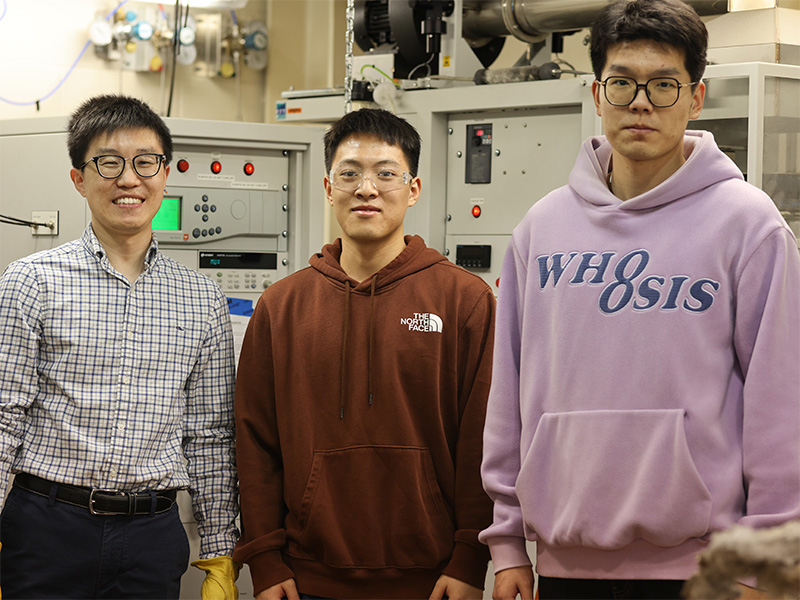
The fellowship will support the advancement of thermo-responsive, water-efficient hydrogels designed to combat some of today’s most challenging fire scenarios: wildland and lithium-ion battery fires.
“Lithium-ion battery fires are driven by thermal runaway, an internal chain reaction that continues to generate heat even after visible flames are knocked down,” Shen said.
These fires may require thousands of gallons of water and can release toxic gases when water comes into contact with damaged battery components.
“In wildland fires, extreme temperatures can cause water to evaporate almost immediately, significantly reducing its cooling effectiveness,” Shen said. “It is also challenging to supply sufficient water to remote or drought-affected regions.”
Shen notes that recent fire events, such as those in Maui, Los Angeles and Oklahoma, illustrate these challenges, with hydrants running dry and system failures caused by power outages and damaged infrastructure.
While water is an efficient fire suppression agent, it only cools the surface and drains away quickly. This drives the need for a more effective, sustainable agent.
Thermo-responsive hydrogels could be the answer. Capable of holding up to 90% water, these hydrogels insulate against heat and resist runoff even under extreme conditions.
The hydrogels behave like liquids at room temperature, making them easy to pump and apply, but transform into heat-activated gels when exposed to high temperatures.
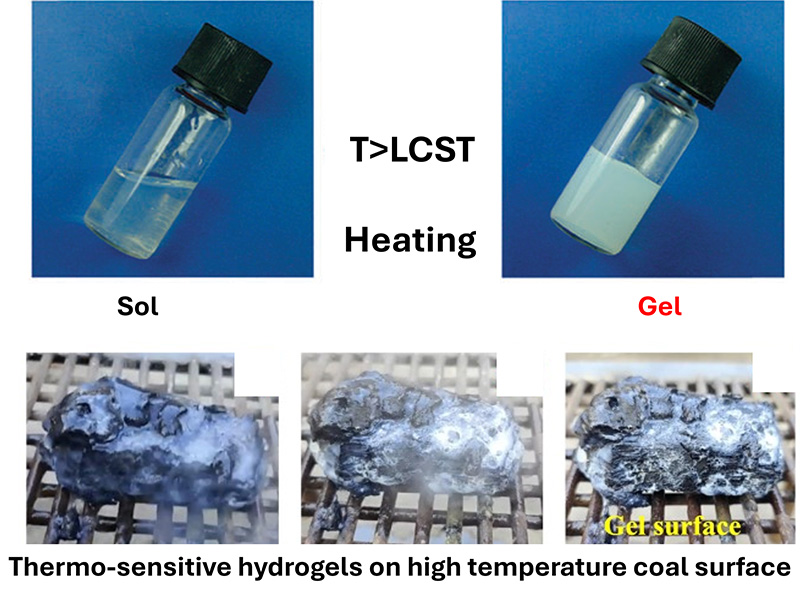
Once in gel form, they cling to burning materials, block oxygen and release stored water slowly as steam. Because these materials are water-efficient, biodegradable and free of PFAS and other problematic chemicals, they reduce overall water demand and environmental impact while offering a cleaner, longer-lasting alternative for communities facing increasing fire risk.
The research is a collaborative effort between OSU and the University of Maryland, two of the nation’s leading fire-related academic programs.
At UMD, Professor Stanislav Stoliarov directs the Fire Testing and Evaluation Center, one of the few facilities in the country equipped for the advanced wildland and battery fire experiments required for this work. Through this partnership, OSU researchers can rapidly prototype hydrogel formulations, validate their performance under controlled fire conditions and incorporate new analytical tools and testing workflows into CEAT’s FPSET labs.
The collaboration also expands OSU’s research capacity, opening doors to future federal and industry funding in addition to providing students with hands-on experience using modern, fire-testing and material-development methods not previously available in Oklahoma.
The fellowship will allow Shen and his team to advance hydrogel development through a series of focused research aims, including optimizing materials formulations, conducting bench-scale fire tests, and investigating the mechanisms that govern hydrogel-fire interactions.
Experiments will be conducted at both OSU and UMD, with support for hydrogel synthesis from Professor Sundar Madihally of CEAT’s School of Chemical Engineering.
Data from bench-scale tests that span a range of fire scenarios will be used to link hydrogel chemistry to real suppression performance.
These tests include:
- Hydrogel synthesis
- Thermophysical testing (LCST measurement, water retention and thermal stability).
- Spray characterization using laser diffraction to measure droplet size and coverage.
- Wildland fire tests in a controlled wind tunnel using fuels like pine needles and wood chips to measure ignition delay, flame spread, and burn-through.
- Battery fire tests to evaluate how hydrogels suppress thermal runaway, reduce propagation between cells, and limit toxic gas release.
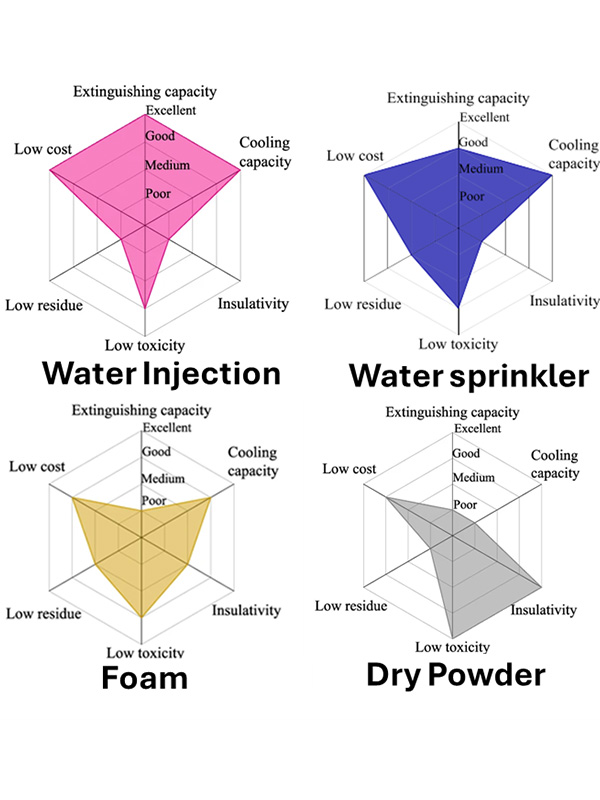
Shen emphasized that this work stands apart from traditional approaches.
“This project is one of the first to systematically connect the material science of thermo-responsive hydrogels with bench-scale fire dynamics for both wildland and lithium-ion battery scenarios,” he said.
Student involvement is a central component of the fellowship. A graduate student will participate in synthesis and testing efforts at both universities, and undergraduate students from FPSET and CHE will assist in research.
Students trained through this project will gain rare, industry-relevant expertise in:
- Battery fire behavior
- Wildland Fire Science
- Advanced suppression materials
- Thermal analysis and fire testing instrumentation
- Safe and effective use of next-generation agents
“This skill set is increasingly in demand across fire service agencies, emergency management, renewable energy industries, vehicle manufacturers and research institutions,” Shen said.
The project can build a pipeline of professionals ready to tackle emerging fire challenges.
In the long term, this technology could become a standard tool in emergency response, helping communities adapt to the increasing frequency and severity of fires.
“If this technology reaches full development,” Shen said, “it could transform fire suppression strategies by offering water-efficient, eco-friendly alternatives for modern fire hazards… and greater resilience for rural and underserved regions with limited firefighting infrastructure.
“I would like to thank Dr. Sundar Madihally for his willingness to support this project. This level of internal collaboration and support within OSU greatly strengthens the project and enhances its potential for success.”