

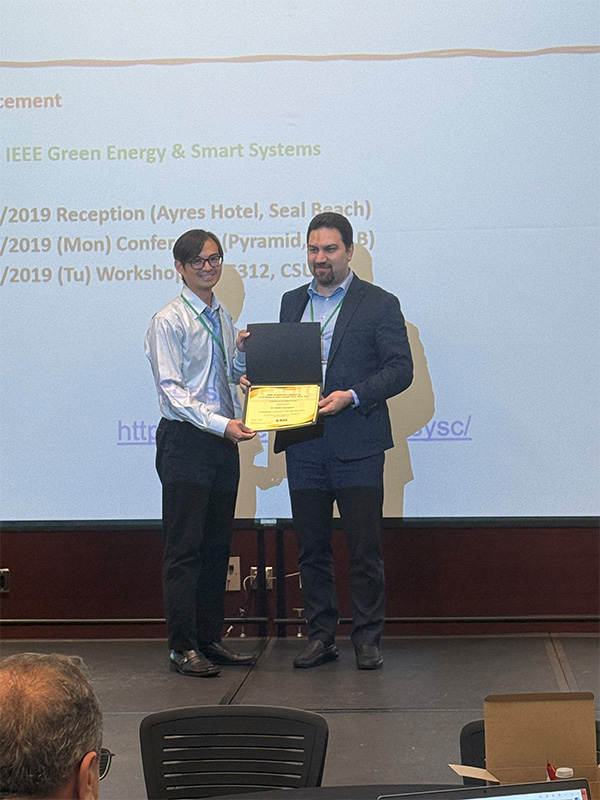
Pouya's research team's success demonstrated at Institute of Electrical and Electronics Engineers
Friday, January 16, 2026
Media Contact: Tanner Holubar | Communications Specialist | 405-744-2065 | tanner.holubar@okstate.edu
The College of Engineering, Architecture and Technology at Oklahoma State University is home to research that transforms the world.
From advancing revolutionary solutions to making lives easier through research, CEAT is a hub of innovation.
Dr. Hamid Pouya, assistant professor and Distinguished Fellow of Electrical and Computer Engineering, and his students were recently recognized for multiple papers that represent CEAT’s commitment to making the world a better place.
Both papers earned awards at conferences held by the Institute of Electrical and Electronics Engineers.
A better energy management system
Pouya and his students, Mahmuda Akter and Zaid Ibn Mahmood, ranked first and earned the Best Paper Award at the IEEE International Conference on Green Energy and Smart Systems in November 2025 for their paper, “A Guided-Deep Reinforcement Learning-Based Approach to Building an Energy Management System.”
This research delved into how deep reinforcement learning, as an AI-based approach, can foster a better energy management system for buildings. Deep reinforcement learning involves the AI program repeatedly performing the same task, learning to make decisions using trial and error.
Optimizing the schedule for household and building appliances has become a more dynamic challenge due to the growing number of controllable appliances and increasing system uncertainties. Conventional energy management strategies can struggle to scale and coordinate decisions effectively.
To overcome this, the team pursued a reinforcement learning approach, or an AI-centered method that can handle the scheduling of large-scale appliances and adapt to time-varying conditions.

“Reinforcement learning learns a control policy through interaction with the environment and reward-feedback,” Pouya said. “Our approach adds a guided element by incorporating domain knowledge during training, which helps the agent learn more reliably and produce decisions that better respect operational constraints in building energy management settings.”
The team used 24-hour residential energy management simulations with hourly decision intervals and broken down into daily “episodes.” Their model factored in non-shiftable household energy use, such as lighting and refrigeration; shiftable appliances like electric vehicles; and other flexible residential demands, with each having their own operating and scheduling constraints.
By training the AI through many daily “episodes,” the system learned robust and adaptive scheduling strategies.
“Simulation results demonstrate that our approach enables more efficient appliance scheduling, thereby reducing operating costs and shifting demand away from peak periods,” Pouya said. “Consequently, peak consumption is lowered, energy use is better aligned with favorable conditions, and appliance and comfort constraints are effectively satisfied.”
Buildings with flexible energy consumption benefit most from this type of approach, especially residential and commercial buildings with electric vehicles and schedulable appliances.
Their models were based on residential buildings with as many as 80 appliances, which can efficiently be managed by their system. A larger scale would be the next step, with office buildings or a university campus being managed by linked building-level controllers that would coordinate with one another.
Pouya sees this type of system management becoming more prevalent in the future, with the use of AI continuing to expand.
“Over the coming decade, buildings are expected to transition from rigid schedules to adaptive, AI-driven operations,” Pouya said. “Such systems will continuously learn from dynamic conditions and occupant behaviors, anticipate future demands, and autonomously optimize energy use while ensuring comfort and adhering to operational constraints.”
The success of this paper within IEEE opened doors for new collaborations and discussions with researchers involved in smart buildings and energy management, even shaping future research goals for him and his team.
“Our next steps involve extending the framework to larger and more complex building environments, enhancing scalability and progressing toward real-world deployment,” Pouya said. “In addition, we plan to investigate robustness under uncertainty and pursue collaborations to enable real-world validation.”
Building up equitable grid resilience
Another paper by Pouya’s team, titled “A Human-Centered Incentive Design for Equitable Grid Resilience in Disadvantaged Communities,” received the Best Paper award at the IEEE Global Humanitarian Technology Conference in October 2025.
The team considered a community disadvantaged when social, economic and structural factors limit its ability to withstand power outages. It can also include lower household incomes, higher numbers of elderly or residents with disabilities, limited access to backup power and underinvested infrastructure.
This research focused on an approach to improving power grid resilience by incorporating human behavior and fairness-aware principles into grid resilience incentive program design. It also considers economic and social factors that strongly influence how a community experiences and responds to power outages.
“The study proposes an equitable incentive framework that encourages the adoption of resilience-enhancing technologies,” Pouya said. “Prospect theory is used to model how individuals make decisions under uncertainty, allowing incentives to align with real-world consumer preferences, risk perceptions and cost constraints. Fairness is embedded through principles that ensure no group is disadvantaged, access to these incentives is fair, and differences between homeowners and renters are considered.”
The team combined technical and behavioral modeling with expert judgment to develop an equitable incentive framework for grid resilience. They sent a questionnaire to power systems and grid resilience experts who evaluated different technologies based on cost, efficiency, safety, environmental impact and noise.
“Overall, this project reinforced the idea that resilience is not just about making
systems stronger, but about making them fairer and more responsive to human needs,”
Pouya said. “Incorporating fairness-aware principles and human behavior factors into
engineering research is essential for creating solutions that are not only effective,
but also sustainable and just.”
These evaluations were put into a multi-decision-making framework and combined with prospect theory to model how users perceive gains, losses and risks when considering resilience investments.
“By combining expert-informed questionnaires, behavioral modeling and fairness-aware evaluation, the research ensured that the proposed incentive programs were technically sound, economically viable and aligned with the lived realities of disadvantaged communities,” Pouya said.
This could have a major impact on disadvantaged communities, as power outages can last longer due to fewer resources for recovery. There are also greater health and safety risks during disruptions, so improving resilience in an equitable manner reduces these burdens.
“By ensuring fair access to resilience technologies and designing programs that consider how people make decisions, equitable grid resilience improves outage preparedness and supports faster recovery,” Pouya said. “At a system level, it also benefits utilities and society by reducing outage-related costs and enabling more efficient, targeted investments. Ultimately, equitable resilience strengthens not only infrastructure, but also trust, inclusion, and long-term sustainability in the energy system.”
Students on Pouya’s team gained experience working at the intersection of power systems, behavioral modeling, and fairness-aware design. They also developed skills in multidisciplinary research, survey design, modeling decision-making under uncertainty, and translating technical ideas into solutions with a real-world impact.
“Overall, this project reinforced the idea that resilience is not just about making systems stronger, but about making them fairer and more responsive to human needs,” Pouya said. “Incorporating fairness-aware principles and human behavior factors into engineering research is essential for creating solutions that are not only effective, but also sustainable and just.”