FEMP researchers publish paper on micromobility for disaster relief
Thursday, February 26, 2026
Media Contact: Tanner Holubar | Communications Specialist | 405-744-2065 | tanner.holubar@okstate.edu
When a disaster occurs, road closures and other hazards can prevent first responders from reaching certain areas impassable by larger vehicles.
In these scenarios, micromobility, or the use of bicycles and other small, human- or electric-powered vehicles, can be used to help get needed supplies to people.
The viability of micromobility in these scenarios is the topic of a research paper published in Nature – Scientific Reports by Qianli Qiu, a student in the Fire and Emergency Management Program in the School of Fire, Construction and Emergency Management in the College of Engineering, Architecture and Technology at Oklahoma State University. Qiu is advised by Dr. Chen Chen, an assistant professor who is also a co-author of this paper.
The paper, titled “The Dynamics of Bicycles for Disaster Recovery and Relief,” examines how useful micromobility would be in the aftermath of a disaster. Using computer simulations, Qiu and Chen tested how operational variables affect micromobility performance.
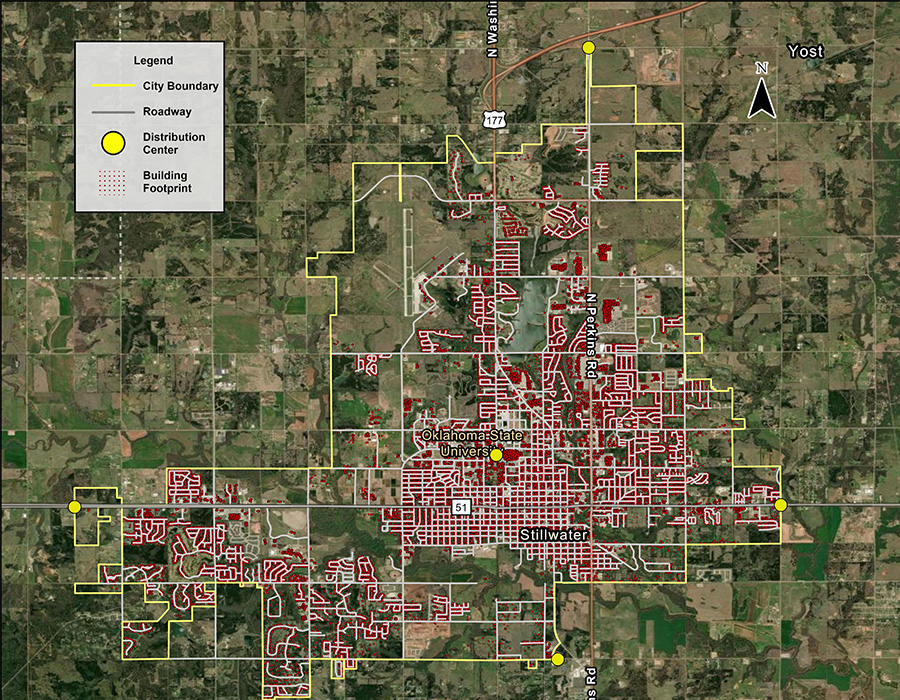
“Using Stillwater, Oklahoma, as the study area, we modeled all households in the city as supply requesters and simulated micromobility deliverers from five resource distribution centers over a 15-day period,” Qiu said. “We measured delivery performance primarily by recipients' average waiting time. We varied three operational factors: the micromobility/bicycle deployment rate, vehicle carrying load and supply allocated per person, and identified operational thresholds where micromobility becomes an efficient supplemental logistics option.”
Their simulations showed that bicycles can be a useful and nimble supplement for distributing supplies in the early stages of disaster recovery. They determined that a small, organized delivery force can distribute supplies within an hour for short-distance, community-scale relief when local agencies are at capacity.
“We stress ‘supplemental’ because micromobility vehicles aren’t a universal or complete replacement for conventional vehicles such as cars, trucks, etc., but they are a useful, resilient option where roads remain passable for light vehicles, and trips are short,” Qiu said.
Using Stillwater as an example in 300 simulations, they determined that if 2% of the town’s residents helped deliver supplies while carrying 18 kilograms of supplies, then each person aided could receive four kilograms of supplies.
One real-world example of micromobility occurred during the 2017 Mexico City earthquake, when bicycles were used to deliver relief to people following the destruction of roadways.
“Micromobility is not viable where travel distances are too long or air and fire hazards make riding unsafe, such as active high-intensity wildfires with toxic smoke and shifting fire fronts; events with many downed power lines that are still energized and unstable structures; or severe floods that cause bridge washouts and submerged roadways," Qiu said.
Qiu, a doctoral student expecting to earn his Ph.D. in 2027, has worked with Chen on disaster relief research since 2023. He has a career goal to become a university faculty member using teaching, research and community engagement to translate emergency management knowledge into practical, community-ready actions.
Having this study published in marks a major milestone in his research journey while also affirming the value of micromobility research through a disaster-resilience lens.
“It is especially meaningful to contribute practical, evidence-based insights to a topic with clear real-world relevance,” Qiu said. “The experience reinforces my motivation to pursue research that not only advances theory but also informs practical preparedness and recovery planning for communities.”
Chen said Qiu’s work ethic stands out among Ph.D. students in FCEM and that he is detail-oriented and a critical thinker.
“This is a big milestone for Qianli publishing such high-quality research in a great journal, and I am so proud of him because this indicates a good start to his academic journey,” Chen said. “I feel so grateful that I can be his research advisor.”
This research highlights the innovative way in which CEAT researchers look to create solutions to real-world problems. By focusing on ways to help communities after a disaster, this research is a prime example of OSU answering the call to utilize research for the betterment of society.