


Engineering a better lift: Multidisciplinary OSU team crafts new model for strength training
Tuesday, February 3, 2026
Media Contact: Tanner Holubar | Communications Specialist | 405-744-2065 | tanner.holubar@okstate.edu
Traditional weight training can come with mental and physical barriers that sometimes feel heavier than the weight itself.
A multidisciplinary, student-led initiative at Oklahoma State University aims to alleviate these barriers through an innovative weight-training design: the Resistive Engagement and Alignment Reinforcer – Gluteal and Erector Activation Rig (REARGEAR 2.0).
REARGEAR 2.0 is a collaboration between multiple disciplines within OSU. Dr. Jason Daniel Miller of the School of Kinesiology, Applied Health and Recreation, Dr. Jerome Hausselle of the School of Mechanical and Aerospace Engineering, and Dr. Harshvardhan Singh of the Human Performance and Nutrition Research Institute, oversaw the efforts of this project, which was showcased at the fall 2025 College of Engineering, Architecture and Technology Senior Design Expo, where it earned first place.
Due to the barriers that older adults, or those recovering from injury, face, traditional weight training is more positively biased toward young adults, athletes and people with high fitness levels, leaving people who can benefit most from traditional weight training at a distinct disadvantage.
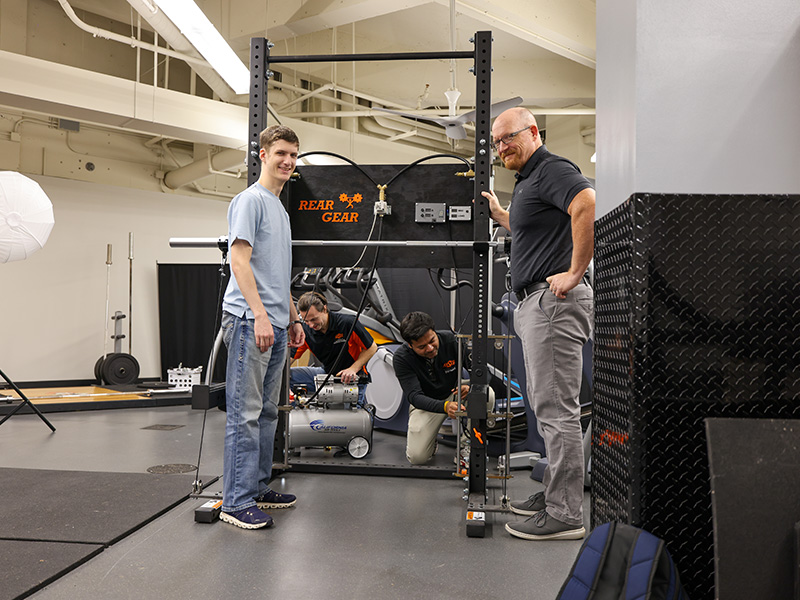
Traditional weightlifting is dictated by a person lifting the heaviest load they can for an entire repetition, going through a full range of motion with the raising and lowering of the weight. During a squat, the thigh muscles experience greater tension while lowering the weight than during the lifting phase.
This means the amount of weight someone can safely lift is not the same for each phase of the movement.
Miller said research and practical experience show that contrast training, using a higher load during the lowering phase and a lighter load during the lifting phase, can improve lifting speed and performance.
REARGEAR is designed to be a customizable, low-cost, scalable and user-friendly alternative using a pneumatic system, where a trainer/spotter manually controls the pre-defined resistances. By applying different resistance levels during each phase of a repetition, it can use heavier resistance during the lowering (eccentric phase) than during the lift (concentric phase). Resistance can also be applied during the phase between lifting and lowering, creating a range of phases that varies with each user. It can also be set to prevent movement at a specific knee joint angle, further benefiting people with joint pain or other mobility issues.
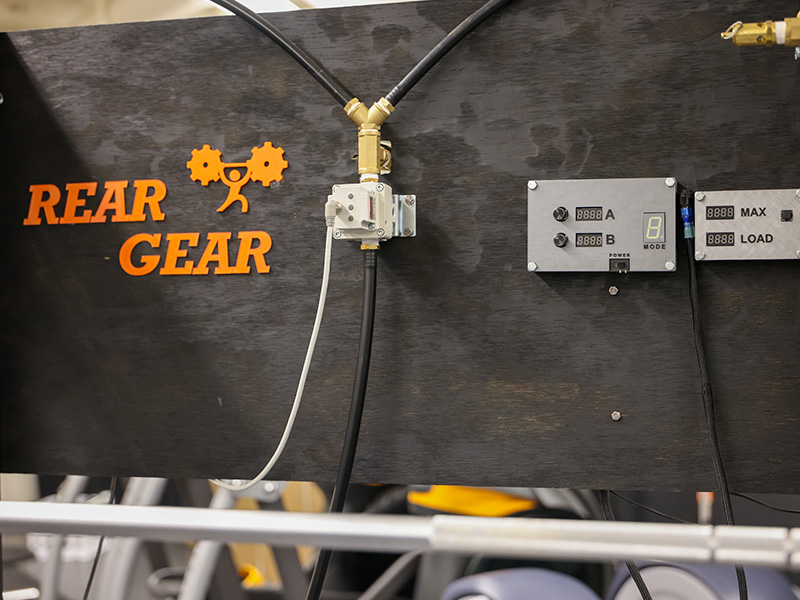
The pneumatic system replaces free weights with air-driven resistance, using pistons and a cable system to simulate the feel of weighted plates.
“Using a pneumatic system allowed us to design a weight training device without any dead weights while still providing different modes of training with differential weights,” Hausselle said.
Cross-campus research
This project is a strong example of the possibilities to solve real-world problems when departments at OSU cross-collaborate.
The student team of Iris Borunda, Ian Craft, Alec Murray, Bruce Smith and Ronnie Walker benefited from the chance to learn from experts in three different areas coming together to combine their experience.
Miller’s expertise in weight training research, Hauselle’s prowess in biomechanics and mechanical design and Singh’s proficiency with applied physiology fostered an environment where the students involved were able to learn from three different perspectives to try and come together to solve one problem.
“Proving themselves to be the axis on which REARGEAR execution was refined and eventually finished, the students showed exemplary rising to the challenges by finishing their assigned job in a highly efficient way,” Singh said. “In addition to finishing the product, in line with the entrepreneurial mindset, the students designed public-friendly communication techniques to share their work at the Design Expo. We are sure that these students are ready for a brighter future.”
Craft and Smith, who expect to graduate in May 2026 and December 2026, respectively, are two students involved in the fall 2025 Senior Design who will continue this research this semester.
Both were inspired to pursue this innovative research due to the efficiency and safety it brings to weight training.
“The rig does not use traditional weights and removes the risk of being crushed at the gym,” Smith said. “It also allows us to overload the eccentric phase of the lift so that the participant can exercise in a way that gives them the most benefit for the time they spend using the rig."
One of the main advantages of REARGEAR 2.0 is its viability with contrast training. This is a method in which the weight resistance is different between the eccentric and concentric phases.
REARGEAR has a mechanism that allows for different weight resistance to be utilized during repetitions. Using the piston and pulley system, more force is applied during the eccentric phase. This is done in real-time by a trainer/spotter using a hand switch that regulates two predesignated weights to be applied for different phases of the lift. It also plays a safer role in neuromuscular development, or when the nervous system learns to optimize muscle control.
“By overloading the eccentric phase, athletes and general users can improve strength, control and neuromuscular development more efficiently than with constant resistance,” Craft said.
The future of REARGEAR
The next step in the evolution of REARGEAR is to further validate its use.
Singh said a study will determine its fidelity, feasibility and efficacy in middle-aged and older adults to study its commercialization/real-world deployment potential. Another version of the project, called REARGEAR in a Chair, will be the team's focus this semester and is targeted to achieve the same outcomes as REARGEAR 2.0 for people who cannot stand or walk independently. Looking back on the experience of REARGEAR 2.0 and Senior Design, Craft and Smith said they gained invaluable experience that will help them in their future careers.
"This project provided valuable experience in system integration, sourcing real-world components, fabrication, testing, and risk management, all of which will directly support my future career in engineering,” Craft said.
By focusing on an innovative approach to weight training, the team of REARGEAR 2.0 is just another example of OSU students striving for excellence with integrity to serve others through innovation and make a true difference in the world.