

SCIVINCE win first at Riata and advances to TigerLaunch global finals
Thursday, March 12, 2026
Media Contact: Tanner Holubar | Communications Specialist | 405-744-2065 | tanner.holubar@okstate.edu
The innovation and interdisciplinary skills of students at Oklahoma State University continue to set a high standard for technological advancement and entrepreneurship.
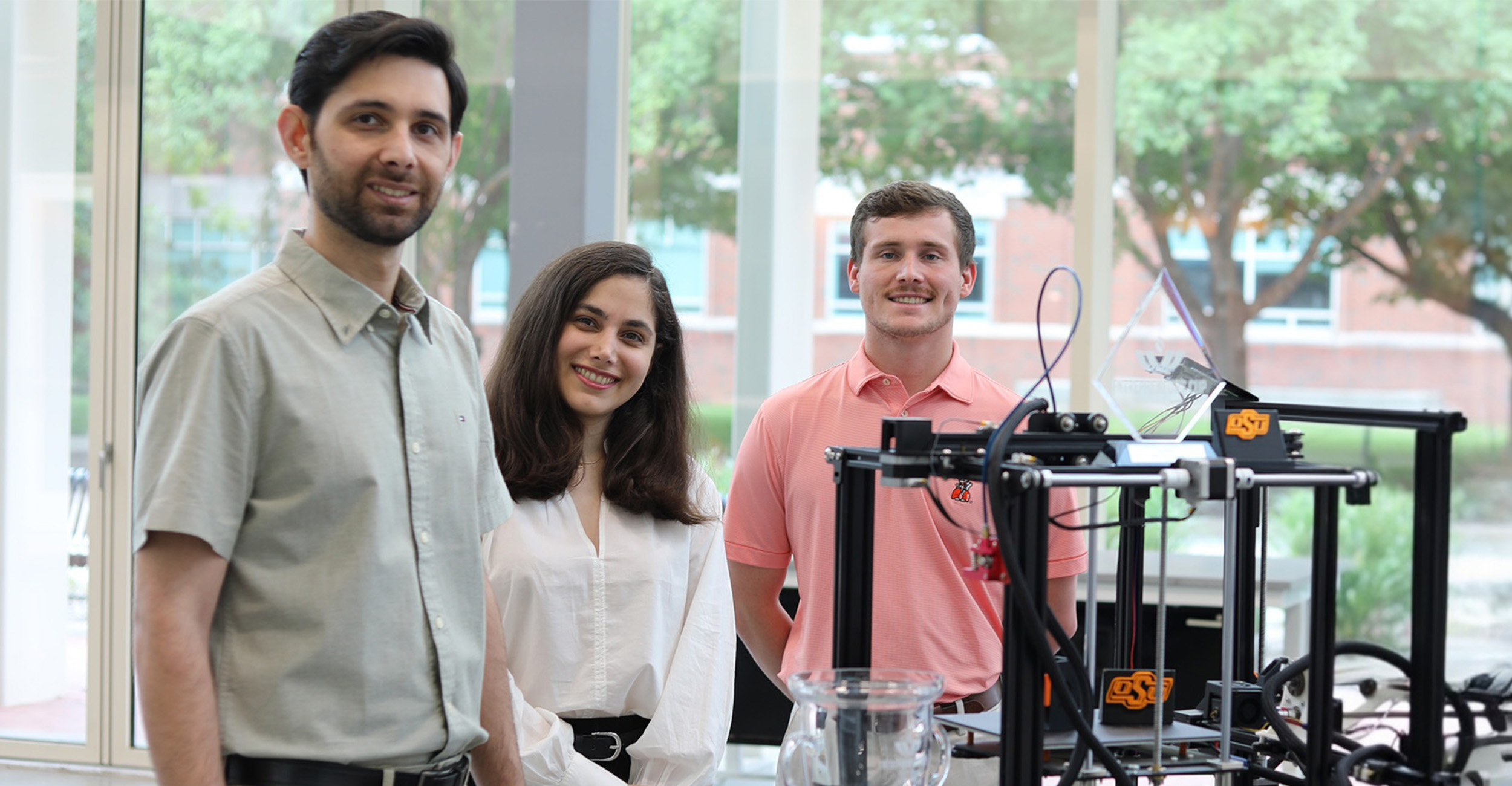
Their first-place finish in the Rising Entrepreneur Track at the 2026 Riata Business Plan competition marks another milestone for the team — Soroosh Farsiani, Mahla Hosseini and William Petty — who are now advancing to the global finals of the TigerLaunch World Cup, the world’s largest student-run entrepreneurial competition, at Princeton University.
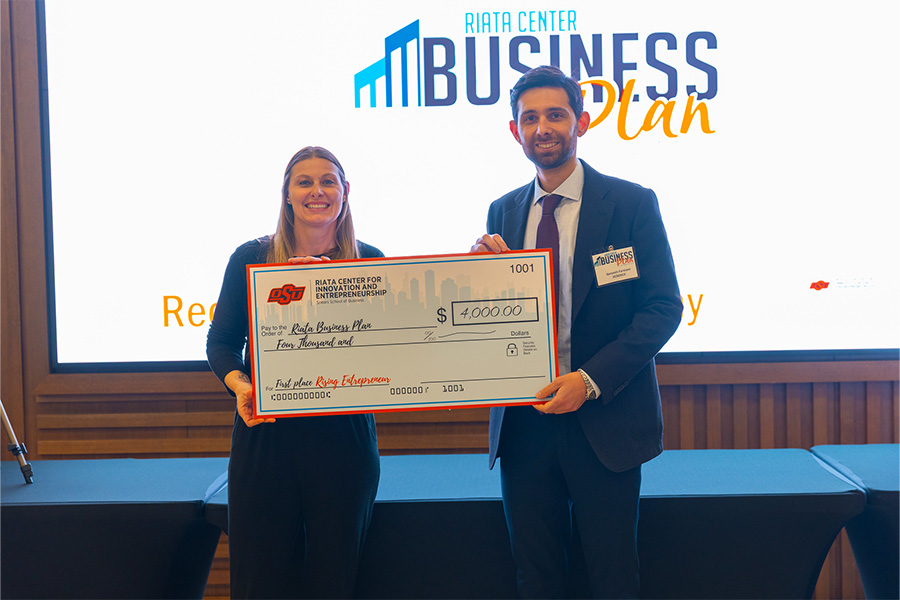
In January, students from OSU earned first place and $4,000 in the Rising Entrepreneur Track at the Riata Business Plan Competition with their commercialization strategy for SCIVINCE, an innovative multi-axis and counter-gravity 3D-printing technology. The team’s winning plan consists of advanced engineering innovation with a strong, data-driven market strategy, setting it apart from others in the competition.
“Each competition has pushed us to refine our market strategy, financial model, and commercialization roadmap,” Farsiani said. “As one of the judges recently said, ‘It gets better every time I see it.’ That comment really reflects our iterative approach.”
Overall, the team has previously received two awards: First Place and $,4,000 in the Big City and High-Tech business track at the Riata Business Competition in January 2025 as well as First Place and $21,000 in the High Growth Division at the Oklahoma Entrepreneur’s Cup in April 2025.
The idea for SCIVINCE began with Dr. Hadi Noori, an assistant professor in MAE. Farsiani and a team of undergraduates have grown the idea into groundbreaking technology. While traditional 3D printers build objects from the bottom up, the SCIVINCE system uses a patented “counter-gravity” method. This enables printing from multiple directions, even from below, allowing complex geometries to be printed without support structures, significantly reducing material waste, post-processing, and manufacturing time.
While the engineering behind SCIVINCE provided a strong foundation, the team’s commercial strategy played an equally important role in their success. Farsiani led the development of the business plan, shaping the overall commercialization roadmap and competitive positioning. Petty, a graduate MBA student from OSU, contributed to the financial strategy development, strengthening the credibility of the commercial plan with judges and investors. Hosseini, a graduate student in the Business Analytics and Data Science (BAnDS) program at OSU with a background in industrial engineering, marketing, and data analytics, built the marketing strategy, identified early customer groups and analyzed where the technology could gain traction the fastest.
“What strengthened our plan was showing how the product fits into real business workflows, not just presenting the technology itself,” Hosseini said.
The team’s business plan was strengthened by more than 200 customer discovery interviews conducted through the National Science Foundation Innovation Corps programs. To date, the team has received $53,000 in NSF I-Corps funding and an additional $30,000 in business plan competition awards.
The team also credited their mentors for guiding the project. Dr. Noori provided technical direction, while Professor David Thomison helped refine the financial model and go-to-market strategy. John Nickles, assistant director of Cowboy Technologies, supported the team through the early stages of commercialization.
Like many innovative projects, SCIVINCE has faced challenges. The team noted that narrowing down market segments to prioritize was difficult, given the wide range of potential applications.
“One of the biggest challenges was narrowing down which market segments to prioritize.” Hosseini said. “There was a wide range of industries that could benefit from our technology, and narrowing them down required a lot of analysis and discussion.”
Another challenge the team highlighted was navigating early-stage funding in a competitive climate, where access to capital for deep-tech innovation has become increasingly selective.
“Securing the right funding at the right time has been a challenge, but it pushed us to build a diversified strategy, pursuing alternative grants and private capital, while staying fully committed to advancing SCIVINCE toward commercialization and economic impact in Oklahoma,” Farsiani said.
Following their success at Riata, the team competed in the second round of the TigerLaunch World Cup at Rice University. Out of more than 500 startups, the team won first place in the regional round and advanced to the finals, placing them among the top seven ventures competing for the $60,000 prize on the international stage. The team will now travel to Princeton University in April and represent OSU as they compete against finalists from across the United States, Europe, Turkey and the Asia-Pacific region in the TigerLaunch World Cup finals.
"Moving to finals gave us the opportunity to compete internationally, representing Oklahoma State University on a global platform,” Farsiani said. “For our team, this is more than a competition; it’s a chance to showcase innovation born at OSU on the world stage."
Story By: Marianne Phu | mphu@okstate.edu