

The human side of warfare: OSU collaboration shaping future of America’s fighters
Tuesday, March 10, 2026
Media Contact: Tanner Holubar | Communications Specialist | 405-744-2065 | tanner.holubar@okstate.edu
Improving the U.S. Department of Defense’s capability to evaluate weapons systems requires more than firepower. It needs engineering precision focused on human-centered design, all in the effort to save American lives.
Thanks to a perfect storm of opportunity, technology and engineering, the Oklahoma State University College of Engineering, Architecture and Technology is actively involved in analysis that makes weapons systems evaluation more manageable for active-duty members of the U.S. Army.
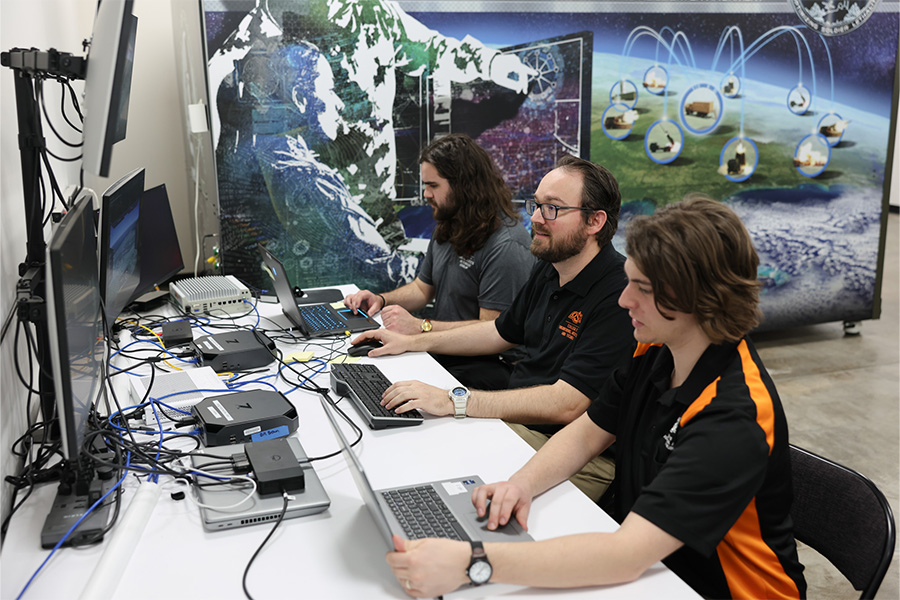
Through a collaboration among Dr. Katie Jurewicz of the School of Industrial Engineering and Management, Dr. Ryan Paul of the School of Mechanical and Aerospace Engineering, and defense contractor Torch Technologies, analysis is underway in Lawton, Oklahoma, aimed at understanding how Army personnel interact with both new and existing weapons systems capabilities.
The culmination of this collaboration is the Soldier Touchpoint Research Center, a $10 million-plus Congressional Add initiative in support of the DOD, which is also known as the Department of War.
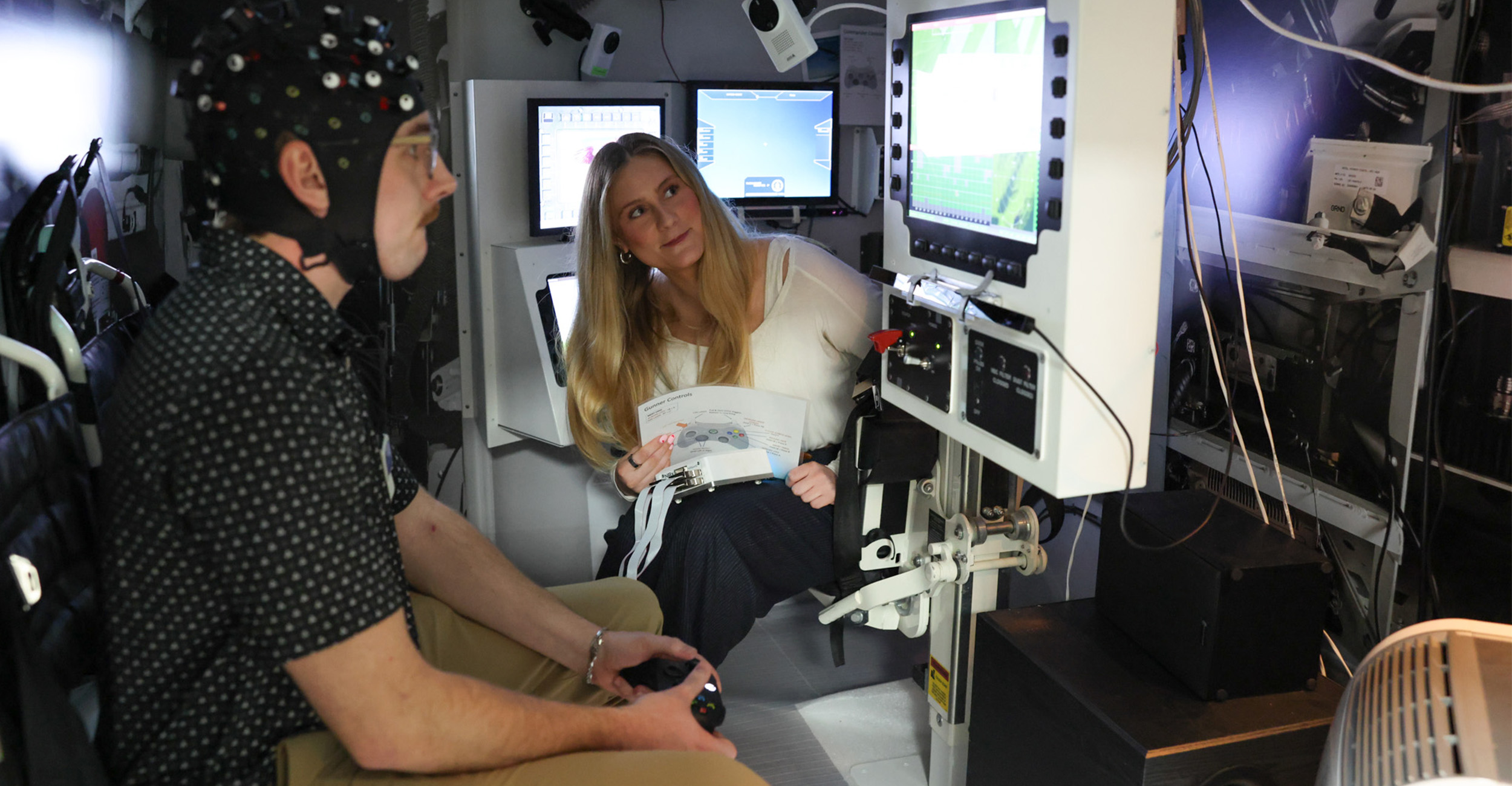
Located in the Fires Innovation Science and Technology Accelerator in Lawton near Fort Sill, Jurewicz, Paul and CEAT students work with Torch Technologies and active military personnel analyzing a soldier’s cognitive state under high-stress scenarios, including where automation could assist in decision making.
The success of the STRC stems from its unique industry-government-academic collaboration, with Jurewicz and Paul combining their respective areas of expertise. Jurewicz specializes in human factors engineering, including theoretical frameworks, physiological and neurological data collection and advanced statistical modeling of human behavior.
Paul’s specialty is building simulated environments, developing real-time data acquisition systems across multiple streams and applying machine learning models to enable adaptive automation.
Working alongside Spencer Knight, Bill Mink and David Lee of Torch Technologies, the collaborators benefit from the unique opportunity to work with soldiers who have already been deployed.
In two virtual simulators that accurately replicate weapons systems used for field artillery and air defense, these soldiers are put through situations they would see in combat. Their experience provides crucial data for the CEAT team in measuring soldiers’ cognitive workloads and quantifying when they experience cognitive overload or underload.
David Lee, a retired colonel and functional analyst with Torch, said the simulators are close to what soldiers see in the field, but also allow exploration and examination of capabilities that haven’t been utilized. He said the physical layout, systems, data feeds and pressures mirror what soldiers experience in a command post.
“We are not guessing what might work,” Lee said. “We are immersing soldiers in realistic scenarios to get quantitative results for improving soldier-machine integration. I think this is especially great since all of this is happening in Oklahoma, tying OSU directly to Fort Sill and the Fires mission, and it's great seeing our state supporting the Army and our nation’s defense in this way.”
Using a multi-sensor data collection suite, the team captures psychophysiological measurements related to cognitive state, including physiological, neurological, and ocular data. Data collection devices include heart and respiration rate monitors, electroencephalography, functional near-infrared spectroscopy, screen-based and camera-based eye tracking systems, as well as video, audio and simulation data.
The team has tested and validated adaptive automation such that when a soldier reaches cognitive overload, as measured through machine learning algorithms built by Paul’s team, the decision aids automatically turn on to offset the cognitive load from the soldier to the automated aids. Jurewicz’s team has built a dashboard that shows the physiological data in real time and uses Bayesian statistical modeling to show the impact of automation on the operator’s evolving cognitive state.
“Cognitive state is not a single variable you can measure directly, and it manifests differently across individuals and contexts,” Jurewicz said. “Much of the literature focuses on a single metric like pupil dilation, heart rate variability or respiration rate, but we designed our system to reflect the complex nature of cognition. We can scale from a device as small as a watch or ring all the way to our complete data collection suite, giving us the capability to quantify cognitive workload in real time, whether in a controlled lab or out on the battlefield.”
Lee said the ability to measure a soldier’s cognitive state is a game-changer for analysis, as it allows one to see when the soldier is overloaded, slowed down or forced to take unnecessary steps. They can then see what improvements can be made to the system to help soldiers in similar scenarios in the future.
Knight said OSU has led this endeavor in a direction that wouldn’t be possible without the combination of collaborators in how to examine soldiers during high-stress scenarios.
"Oklahoma State is on the cutting edge of its engineering and research," Knight said. "They are doing some things that have never been done before in the DOD."
Oklahoma provides a unique partnership
This collaboration began in November 2023 and addresses a longstanding deficiency that had persisted for many years. Fort Sill houses the U.S. Army Field Artillery and Air Defense Artillery schools.
Fort Sill is also home to organizations that are part of the Transformation and Training Command, a 2025 initiative to unify force design, generation and development to accelerate the Army's modernization.
"The key leaders at Fort Sill don't just shape what gets built, they define the requirements that drive it," Knight said. "As subject matter experts, they're the ones telling material developers what's needed. And when that capability comes back to Fort Sill, they're the ones putting it in soldiers' hands. The STRC is what connects all of it: requirements, development, testing and validation all running through one place, with the STRC Lab offering a faster and more cost-effective way to accelerate human readiness levels through Soldier-centric design.”
The 2025 National Defense Authorization Act includes language recommending military tech to be developed with human readiness levels in addition to technology readiness levels and meet certain thresholds before being fielded.
“Defense technology needs to be developed such that it is fully capable from the technical side, representing its technological readiness, as well as from the human side, where developers and researchers can be confident that a technology is ready for human use, too,” Jurewicz said.
Invaluable student experience
This collaboration provides many tangible benefits for CEAT students, with many discoveries garnering interest from senior military leaders and the DOD.
Mink said the progress made over the two years of the collaboration is largely due to the students' innovation and work ethic. He said they provide a unique perspective on how they approach problems with a desire to learn and push the initiative forward.
"The ability for students to work with active-duty soldiers and see that their research matters is very important," Mink said. "The work that they're doing is going to be implemented in weapons systems that will help save lives."
Working at FISTA also gives students an advantage, as they can network with defense contractors, which can lead to job opportunities. Torch Technologies was the first company on-site at FISTA to begin working with soldiers stationed at Fort Sill, and many other defense contractors have moved into office space in the FISTA since 2023.
Ainsley Kyle, an IEM Ph.D. student, has been part of this collaboration since its foundation. After being involved with STRC at its outset, she interned with the U.S. Navy and the Air Force Research Laboratory.
"The work we are doing for adaptive automation and applied neurophysiology quantification is ahead of the other work we read about in the open literature. It is rare to have a team in which the span in expertise across human factors, real-time multimodal data collection and advanced data analytics at OSU meets high-fidelity simulation environments built by Torch, and all of the analysis can be conducted using the true end user in Lawton," Kyle said.
Melissa Mata, an IEM master's student, has been involved with this project since January 2025. She said it has exposed her to new career paths.
"The exposure STRC has provided me to defense opportunities has shaped my career outlook that I would not get at any other university,” Mata said. "Being a part of STRC and seeing that I can do work that makes an impact within the DOD and other applications means I can kind of bridge neuroscience and human factors engineering together. I am now pursuing a Ph.D. at OSU in IEM after my master’s because it really is such a unique opportunity that doesn’t come around too often for students. "
The methodology employed is applicable in several industries, such as aerospace, transportation and even health care.
Matthew Nare, an IEM Ph.D. student whose dissertation is health care-focused, has worked with several hospitals on how systems and resilience engineering frameworks support health care workers.
Surgeons and nurses operate in environments that are physically demanding and mentally taxing, like soldiers on a firing mission.
"Soldiers, like surgeons, represent a highly specialized, rigorously trained population, yet unlike operating rooms, the STRC provides a controlled experimental setting where multimodal physiological and neurological data can be collected without the ethical and logistical constraints inherent to health care research," Nare said.
Influencing the future of the warfighter
This collaborative initiative is incredibly beneficial to the state of Oklahoma and the DOD by saving American lives. Focusing on such a crucial aspect of U.S. national defense is also key to OSU’s mission as a land-grant university.
The team is answering the Cowboy Code by providing crucial data on soldiers' cognitive load in high-stress situations, trailblazing at the forefront of keeping America’s warfighters safe.
"There are lots of industry partners and universities, but to have all three elements coming together is critical to execute this kind of work," Mink said. "The Army is focused on soldier-centered design, and this type of work enables that type of functionality to benefit the warfighter and the DOD."