

The Last Frontier: CVM’s impact extends from Stillwater, OK, to Anchorage, AK
Thursday, November 20, 2025
Media Contact: Kinsey Reed | Communications Coordinator | 405-744-6740 | cvmcommunications@okstate.edu
Mathematics Meets Mushing: OSU professor’s passion for sled dogs inspires
students and community
As a mathematics professor, Dr. Doug Aichele has spent years sharing his knowledge and passion with his students.
However, one of his most treasured passions goes beyond his love of teaching and mathematical research.
The Oklahoma State University professor emeritus and Regents Professor loves sled dogs. Not something that is very common in Stillwater, Oklahoma.
Aichele never imagined that a simple veterinary referral would lead to a lifelong connection with the OSU Veterinary Medical Teaching Hospital.
However, that’s exactly what happened when Rico, one of his beloved sled dogs, needed treatment for a bad tooth.
Dr. Heather Crawford, an OSU alumna, sent him to the CVM for treatment. From that moment on, Aichele and his team of sled dogs became more than just patients; they became part of the OSU CVM family.
Aichele’s dogs aren’t the typical patients seen at the hospital. Each one has been a working sled dog, and part of a team that once raced across frozen landscapes, pulling sleds through some of the harshest conditions imaginable.
Aichele’s interest in Alaskan Huskies was motivated initially by his wife’s sledding experience with them in Fairbanks, Alaska. His real-life involvement with these amazing animals began in 2009 when he connected with Gumbie, a dog who had just completed the grueling 1,000-mile Yukon Quest and was being considered for the team on the upcoming Iditarod.
Their instant bond led to the creation of a growing pack of sled dogs, each with a unique journey and place in Aichele’s heart.
Reaching up, placing his paws on Aichele’s chest and looking into his eyes, Gumbie claimed him as his own. By June of that year, Gumbie was no longer in Alaska. Gumbie went home to Stillwater, the first of many sled dogs to become part of Aichele’s family.
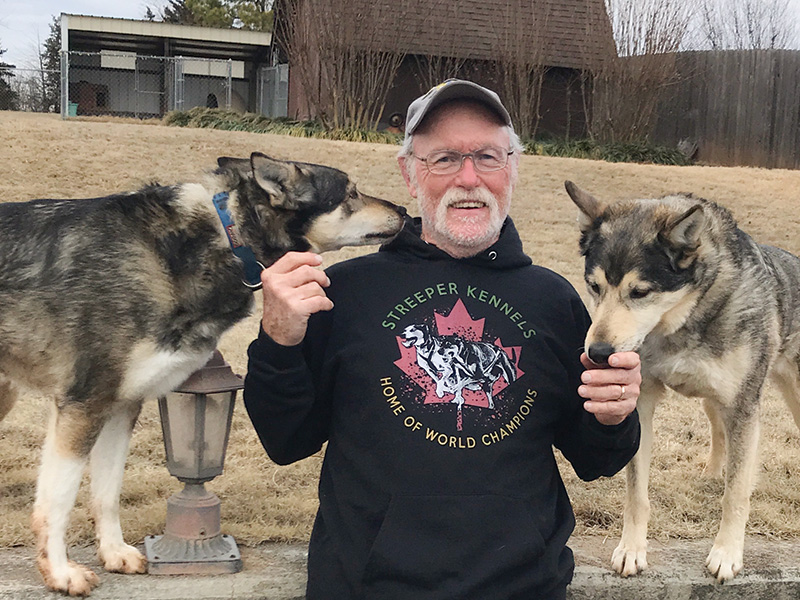
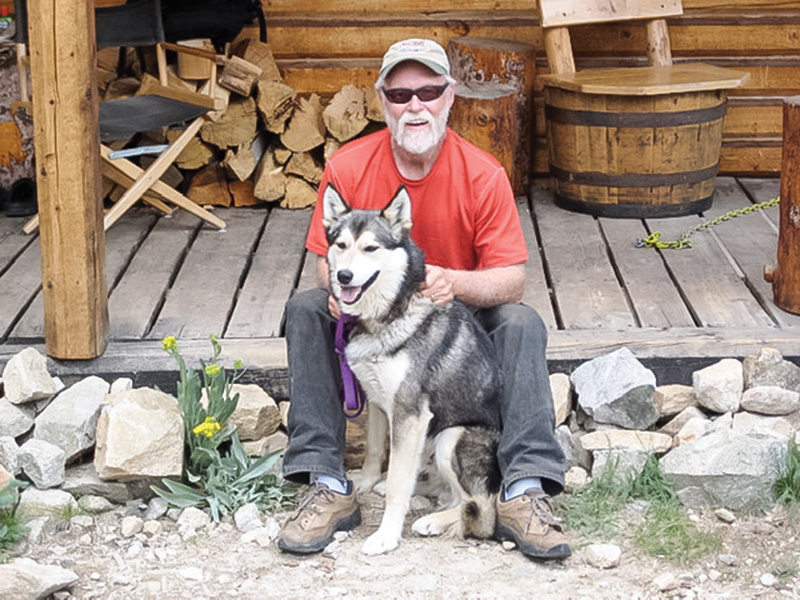
Over the years, the Aichele pack grew. Gumbie and his kids, Vulcan and Vixen, Rico, Gabbie and Turtle are all cherished members of their team.
“The first thing we do when we get a new dog is bring them straight to the teaching hospital to see Dr. Lara Sypniewski for a checkup,” Aichele said.
When a new sled dog joins the Aichele family, they visit the veterinary teaching hospital to ensure they are healthy and ready to settle into their new home.
“Doug is incredibly committed to the health and welfare of his dogs; any dog that crosses the threshold into their pack has literally struck the jackpot,” said Sypniewski, a clinical associate professor in small animal primary care.
Aichele’s bond with OSU extends beyond his dogs’ care. With deep ties to the university and the Iditarod, Aichele provides invaluable insights to OSU’s fourth-year veterinary students during their rotations in Alaska.
His passion for sled dogs is woven into every aspect of his life, even honored in stone. Each dog has an Onyx brick at OSU dedicated to them as a tribute. His friends affectionately call it “Aichele’s Alley in the Onyx Courtyard.”
Aichele actively shares his story with the community, visiting elementary schools to inspire young minds and promoting the dogs and sport he loves.
He also speaks to over 60 civic groups and local organizations, covering states from Oklahoma to Colorado. Aichele can be heard ending his presentations with the same refrain: “It’s All About the Dogs!”
Aichele and his trail crew were recently honored with the Golden Clipboard Award during the 53rd Iditarod, a recognition given by the mushers to the checkpoint trial crew they found most helpful along the trail.
Although Aichele remains busy advocating for sled dogs, he remains deeply committed to the OSU CVM and its students, dedicating his time and expertise to shaping the next generation of veterinary professionals.
A Dream 30 Years in the Making: Dr. Lacey Loveless and the 2025 Iditarod
For Dr. Lacey Loveless, the 2025 Iditarod wasn’t just another line on her résumé — it was the culmination of a dream that had been quietly growing since childhood.
Loveless moved frequently during her childhood due to her father’s work in the oil industry, eventually settling in Anchorage, Alaska, around age 10. There, she was introduced to the Iditarod, attending the ceremonial start each March with her family. The event became a meaningful tradition and sparked a lasting interest in sled dog racing.
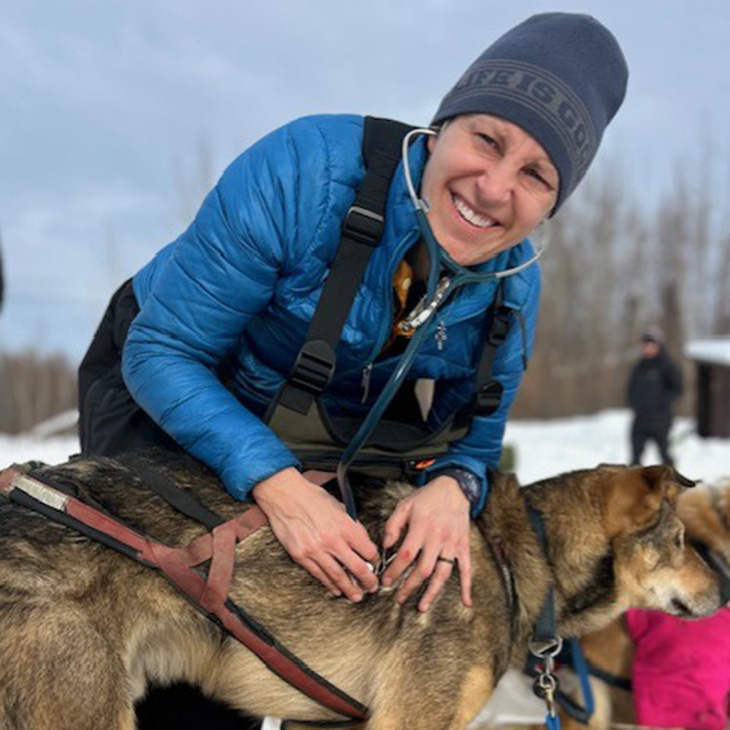
Although her path took her far from Alaska — first to Baylor University in Waco, Texas, then to Oklahoma State University for veterinary school, and later into a busy small animal practice in Fort Worth, Texas — Loveless continued to follow the Iditarod each March.
She closely tracked the mushers and race updates, always holding onto the goal of one day returning to the trail, not as a spectator, but as a veterinarian caring for the sled dogs.
Pursuing that dream took time. Life moved quickly — she met her husband, also a veterinarian, while at the OSU College of Veterinary Medicine and graduated in 2009.
Together, they built their careers in Texas, spending a decade in small animal practice. In 2019, they returned to Oklahoma and launched a veterinary relief business, a move that finally gave her the flexibility to pursue the opportunity she had been quietly holding onto for more than 30 years.
In 2025, it all came full circle. Loveless was accepted as one of eight rookie veterinarians to serve on the Iditarod trail.
“It was literally 30 years in the making,” she said. “I always had it in the back of my mind — ‘This is something I want to do.’”
Before the race even began, she and her fellow rookie veterinarians arrived in Alaska for a weeklong sled dog veterinary conference and performed pre-race physicals on every single dog that would hit the trail. After that, the real adventure began.
Working as a trail vet is not for the faint of heart. There’s no set schedule. You find out where you’re going sometimes only hours in advance.
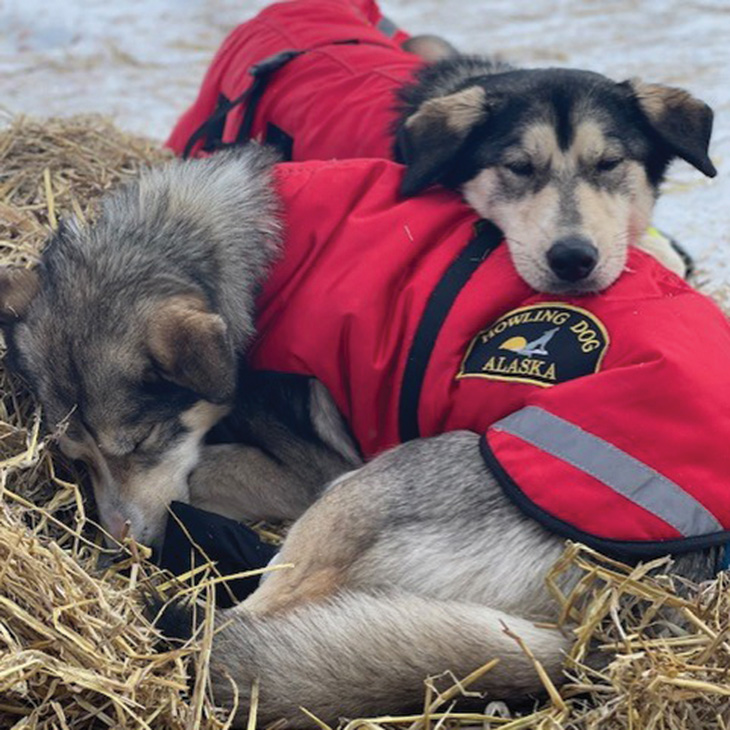
You hop in a bush plane — sometimes a commercial charter, sometimes a tiny two-seater — and land in remote Alaskan villages where the wind howls and temperatures can drop well below zero.
“You have to be super flexible,” Loveless laughed. “If you’re not, this probably isn’t the job for you.”
Her job was to monitor the health of every dog passing through her checkpoints, sometimes doing full physical exams, sometimes just putting eyes on each athlete to make sure they were healthy.
Most of the issues were typical of any high-endurance athlete: sore feet, mild lameness, fatigue, or the occasional upper respiratory issue.
Emergencies were rare, but not unheard of. And with a veterinary team that included everyone from general practitioners to board-certified surgeons and pathologists, they were ready for anything.
Still, for Loveless, the most striking part of the whole experience was the dogs themselves.
“They’re just the coolest creatures ever,” she said. “People might think they’re being forced to run, but if you’ve ever seen them take off at the start, you’d understand. That’s all they want to do. They’re so conditioned, so excited and so incredibly well-behaved.”
These aren’t your average clinic patients. While a typical exam room might require multiple techs to hold a wiggly dog still, Iditarod sled dogs lie down, curl up and calmly let the veterinarians do their work, she explained.
“They’re the stars of the show,” she said. “And they know it.”
The sense of camaraderie among the veterinary team was another highlight. As a rookie, Loveless was warmly welcomed by the seasoned veterinarians, some of whom had been working the race for over a decade.
They offered advice not just about the dogs but also about the lifestyle: where to sleep, how to store gear and what to expect when exhaustion sets in. By the end of the race, friendships had been forged.
“It’s something I absolutely hope to do again,” she said. “Once you’ve done it, you know what to expect, and that makes all the difference.”
With support from her husband, her parents and a lifetime of quiet determination, Loveless turned a childhood dream into a reality. And in doing so, she reminded everyone that sometimes, the best stories are the ones that take the longest to write.
The Last Great Race on Earth: Fourth-year veterinary students volunteer at 53rd Iditarod Trail Sled Dog Race
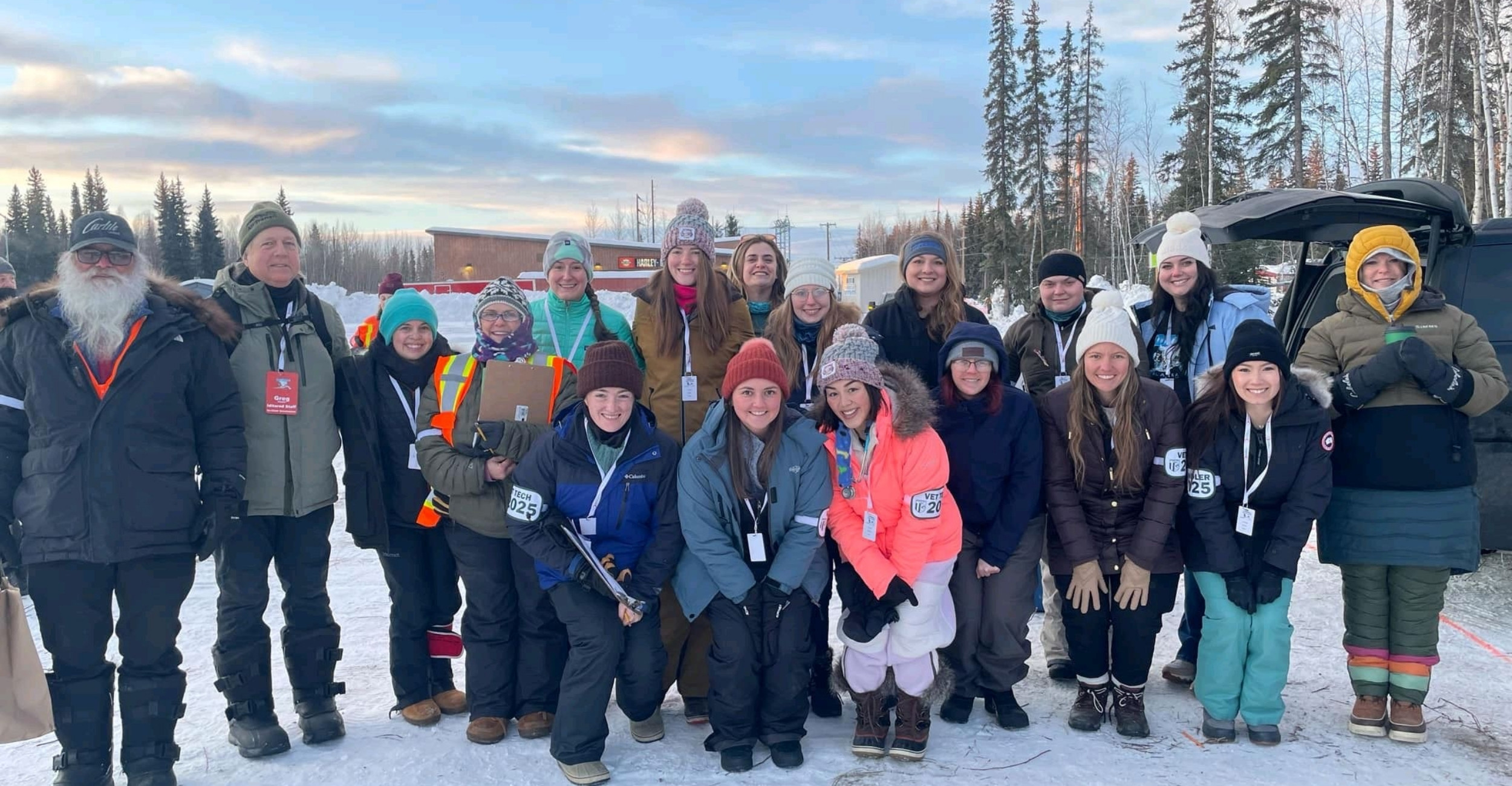
For 12 fourth-year Oklahoma State University College of Veterinary Medicine students, a veterinary rotation in Alaska became an opportunity of a lifetime: volunteering at the 53rd Iditarod Trail Sled Dog Race, often called “The Last Great Race on Earth.”
The annual event is a 1,000+ mile journey across the icy Alaskan wilderness, testing the endurance and resilience of mushers and their teams of elite sled dogs. This year, the race route was extended to around 1,150 miles (about the distance from Oklahoma City to Pittsburgh) due to a relocated start in Fairbanks, a change prompted by poor snow conditions in Anchorage.
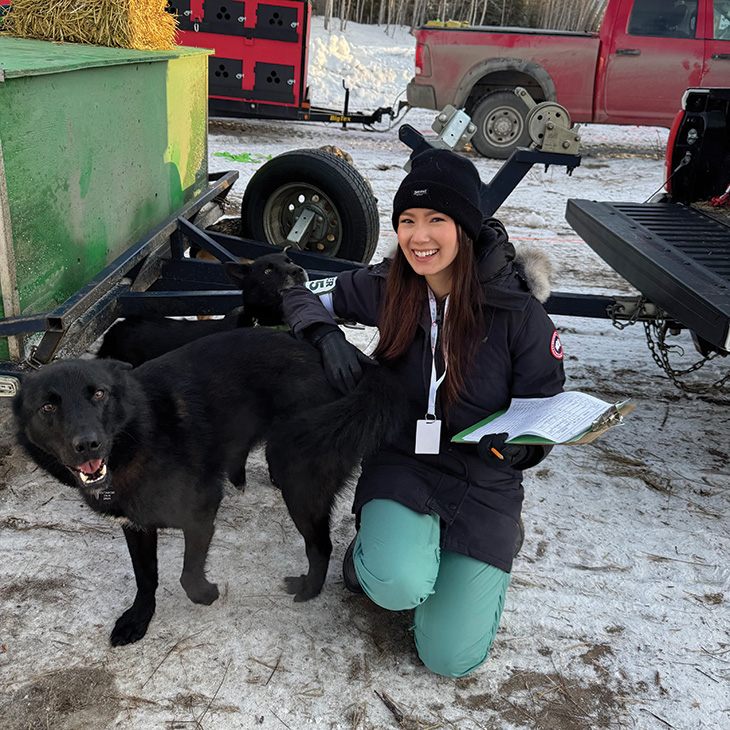
While the students originally traveled to Alaska for a canine exercise physiology rotation led by Dr. Michael Davis, OSU CVM professor and a specialist in sled dog medicine, their experience expanded significantly when they took the initiative to get involved with the Iditarod.
“I just thought, ‘Why not reach out and ask?’” student Ally Williams said. “We were sitting around talking about how cool it would be to go to the start of the race, so I emailed the head veterinarian.”
Although all official veterinary positions had been filled, the students were eventually connected with the veterinary technician and offered roles supporting the restart in Fairbanks. Davis gave the green light for their participation, and the students hit the road — literally — with a five-and-a-half-hour drive from Wasilla to Fairbanks.
Kammy Bene, another student, was instrumental in igniting the group’s interest in volunteering.
“I just threw the idea out there during our first couple of days in Alaska,” Bene said. “Next thing we knew, we were researching how to get involved.”
Their official role on race day was to scan and verify the microchips of each sled dog before the race began — a vital part of the Iditarod’s identification and health tracking system. Each dog’s microchip links to its medical record and helps prevent confusion throughout the race’s many remote checkpoints.
“Every team has 16 dogs, and with 33 teams, that’s over 500 dogs we helped process,” Williams said. “We split up, and each group took on a handful of teams. It was pretty incredible seeing it all come together.”
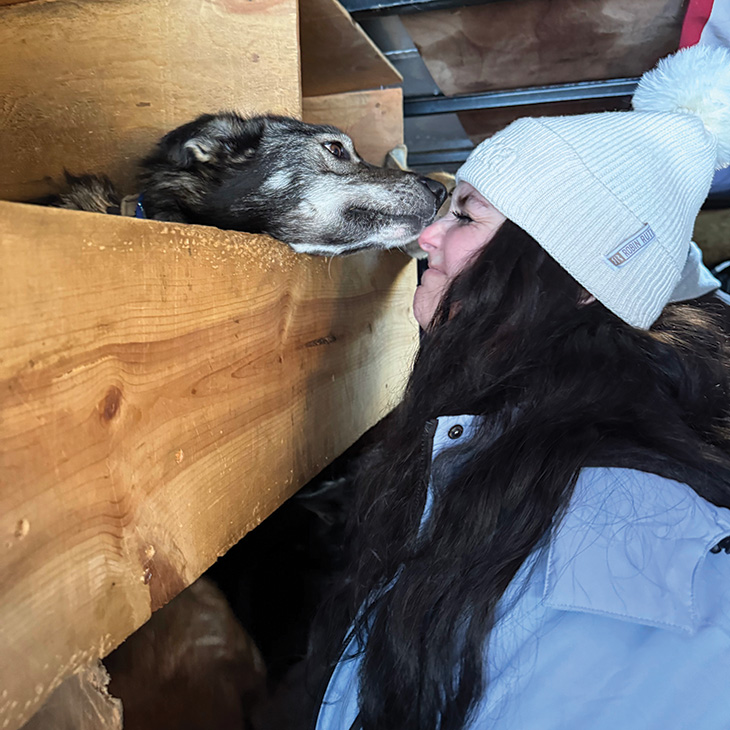
The students gained firsthand insight into the incredible physical capabilities of sled dogs, which thrive on the intense demands of long-distance racing.
“The Iditarod was especially interesting to me as a veterinary student because, throughout Dr. Davis’ lectures on our rotation, we learned about the vast array of physiological differences these canine athletes have compared to pet canine companions,” student Madie Petree said. “It was amazing to then be able to see those talented dogs working right in front of my eyes and to apply that knowledge as we were getting to meet them.”
At each checkpoint along the Iditarod trail, a team of veterinarians is flown in via bush planes to assess the dogs’ health. If a dog is injured or too fatigued to continue, it is safely dropped from the race and cared for until it can be reunited with its handler.
“It was fascinating to learn how dedicated these teams and veterinarians were to ensuring quality medical care even in the face of harsh and isolated conditions,” Petree said.
The experience left a meaningful impact on each student. For Bene, what resonated most was the electric atmosphere surrounding the race.
“Watching the dogs jump with excitement at the starting line was my favorite,” she said. “It was a contagious energy — between the dogs, the mushers and the crowd, you could feel how special it was.”
While the students only volunteered for one day during the official restart, their impact — and the experience itself — was significant. As the first OSU DVM students to volunteer at the Iditarod, they’ve set a precedent for future rotations.
Photos By: Provided
Stories By: Kinsey Reed and Bailey Horn | Vet Cetera Magazine