

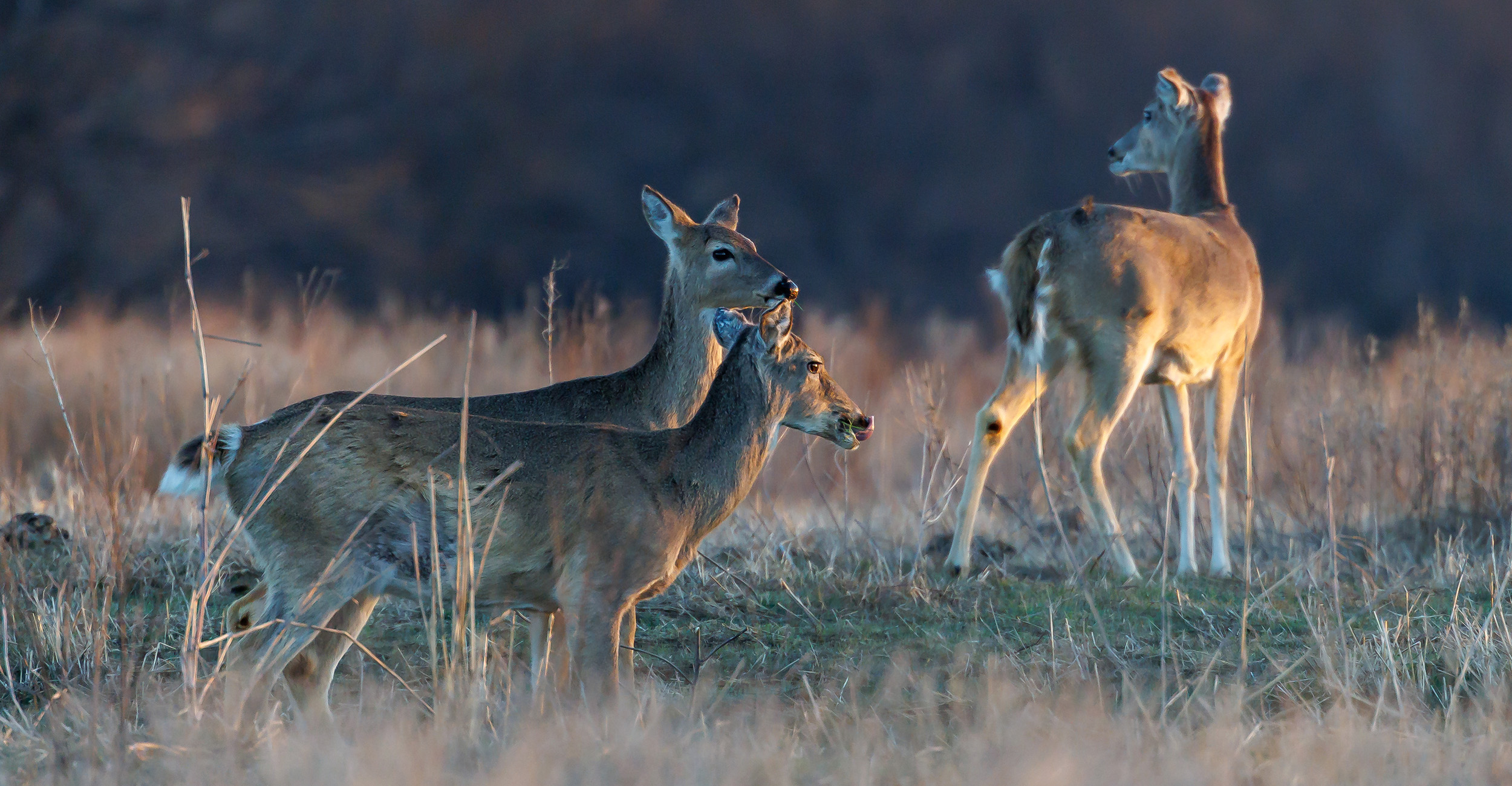
Chronic wasting disease is in Oklahoma; OSU Extension tells you what you need to know
Wednesday, March 18, 2026
Media Contact: Dean Ruhl | Office of Communications & Marketing, OSU Agriculture | 405-744-9152 | dean.ruhl@okstate.edu
In February, a harvested deer tested positive for chronic wasting disease in Cimmaron County. This became the fourth deer in as many years to test positive for the disease in Oklahoma.
Chronic wasting disease (CWD) is a fatal, neurodegenerative prion disease. Prions are misfolded proteins that lack DNA or RNA. CWD affects cervids such as white-tailed deer, mule deer and elk. Mark Turner, Oklahoma State University Extension wildlife specialist, helps explain the disease and what hunters need to know.
“There is no cure for it,” Turner said. “There is no vaccine for it. In humans, it’s similar to Creutzfeldt-Jakob disease (CJD). In cows, there is mad cow disease.”
With the latest positive case, Turner offers tips to mitigate the disease.
CWD has not been shown to infect humans
To this point, there is no evidence suggesting CWD is transmissible to humans, Turner said. However, it is possible the disease may affect humans at some point because of similarities to other prion diseases.
But that doesn’t mean caution shouldn’t be taken. If hunting in an area where CWD has been documented, Turner recommends getting harvested deer tested by local state agencies. This can be as simple as turning in the head of a harvested deer to a testing site. Testing sites are currently provided in CWD-positive areas.
“There are no cases directly linking CWD in a deer to CJD in humans,” Turner said. “However, there certainly have been cases with humans contracting CJD associated with mad cow disease, so that gives us a little pause. We would not recommend eating meat from an animal infected with CWD.”
Because it is a prion-based disease, cooking the meat to the standard 165 degrees Fahrenheit to kill bacteria will not work.
“The incinerators that are used to dispose of meat and other infected materials are cooking at well over 1,000 degrees,” Turner said. “There’s no way to cook it out of the environment.”
Symptoms aren’t always present
Late-stage CWD deer may present symptoms. The deer may be stumbling around aimlessly, showing signs of neurological damage. There can be extreme weight loss, excessive salivation and drooping ears, too.
But CWD-positive deer don’t always display signs. As Turner explains, infected deer can live 12-18 months, during which their condition deteriorates slowly. From a disease-management perspective, the slow progression makes detection difficult.
“If you harvest a deer or see a deer on your property, you can’t always tell by looking at it whether it has CWD or not,” Turner said. “That’s why we recommend testing.”
If you see deer acting strangely, report it to the Oklahoma Department of Wildlife Conservation, via your local game warden or by calling 405-521-2739.
Be vigilant with biosecurity
Deer generally do not move vast distances throughout their lives. The spread of CWD predominantly comes from people moving deer, alive or harvested, long distances.
If you are harvesting deer in a CWD-positive area, always de-bone your meat at the site of the kill or relatively close, Turner recommends. Avoiding moving animal parts, except for de-boned meat, is a great step hunters can take.
The spread of the disease can be devastating for the deer population. As Turner explains, the impact will be minimal in the first few years. But over decades in a place like Wyoming, where CWD has been present for more than 40 years, there are dramatic decreases in deer survival.
“This tends to decrease the age structure of the deer population,” Turner said. “Those animals can’t live very long. They’re not going to be productive, and you’re going to see decreases in the population.”
How this is transmitted
This disease spreads primarily through animal-to-animal contact, through saliva and droppings.
But these prions are extremely resilient and can survive in the environment for years. If a CWD-positive deer dies and decomposes, new plants in that location can take up the disease, and if another deer eats those plants, it can become infected.
“Prion diseases are a very different type of disease compared to either bacterial infections or viral infections,” Turner said. “They’re kind of their own thing, and unfortunately, right now these are always fatal [in deer].”