


Cowboys Care: A rapidly growing movement with personal roots
Wednesday, January 7, 2026
Media Contact: Mack Burke | Associate Director of Media Relations | 405-744-5540 | editor@okstate.edu
As a young girl, Angela Hess often felt overwhelmed and so consumed by her racing thoughts that she couldn’t sleep at night or focus during the day.
Every day, she would be so distraught that her parents had to come pick her up from school.
She experienced several challenges during her early childhood, intense emotions when separated from family, reflection on life and what happens after, things not typical for a 5-year-old.
Conversations surrounding the topic of mental health were not common practice during this time, so no one around Hess — teachers, friends or family — knew the cause of her struggles.
“It was not an open discussion, anywhere,” Hess said. “We didn’t take those problems to church, as my parents always said. So, I put on a happy face and went on about my days.”
Later in life, as Hess started a family of her own, she began to notice similarities with struggles her son was facing — things she was all too familiar with — heightened emotions, lack of focus, among others.
She began researching ways to help alleviate these symptoms and seek treatment. She also started seeking counseling to talk through these struggles with professionals. The moment Hess began sharing her life stories and struggles, she realized that she had been dealing with heightened anxiety since she was a young child.
“Through conversations with amazing mental health professionals, I recognized that I had my first panic attack when I was 5 years old,” Hess said. “I had been living my life with anxiety buried beneath a smile.”
The Hesses have continued to face struggles surrounding mental health — through family and friends — throughout their lives.
So, when her husband, Jim, was asked to become the next president of Oklahoma State University, and they decided to make the move to Stillwater, Angela had one simple request.
“Can we share our story about mental health?” Angela asked. “I wanted to use my story and our story to help others who were facing similar struggles. I wanted them to know that they weren’t alone.”
A movement is born
As the Hesses settled into their new routine, a chance meeting with an equally passionate student spurred the movement Angela had envisioned into high gear.
Bella Ridener, a psychology junior and student intern in the president’s office, asked to meet with the president and first cowgirl to discuss a passion that was close to her.
“We sat down for that meeting and quickly realized that we shared this passion for mental health awareness,” Ridener said. “When I found out that Angela and I shared this common passion, we could not stop talking about ideas. She encourages me to allow others to feel seen, valued and more confident that the university is committed to creating a community where mental health and wellness are a priority for students.”
And thus the Cowboys Care initiative began to take shape. After countless meetings and tireless efforts from partners across the university, a framework and roadmap forward for Cowboys Care were developed to be unveiled to the entire OSU family.
“I wanted to use my story and our story to help others who were facing similar struggles. I wanted them to know that they weren’t alone.”
— Angela Hess, OSU first cowgirl
The initiative was introduced at the annual Rock the Block event in August at the Colvin Recreation Center. It encompasses various resources and programs across OSU, including clinical counseling, health services, wellness and prevention programs, and a student support system. The initiative also encourages students to look out for one another and to seek help when needed.
“Our goal is to make this a comfortable conversation,” Angela said. “We want our faculty, staff, students, parents of students, everyone to be comfortable seeking help for themselves or someone they know.
“We have great resources available, not just in Stillwater, but across the entire OSU System, and we want those in need to feel comfortable getting connected to those resources.”
The Cowboys Care initiative continues to build upon a solid foundation of resources already in place, such as the TimelyCare program, which is available to students 24/7 and connects them to services including: an instant messaging platform, scheduled counseling, health coaching, self-care content, basic needs support and a peer community forum.
“This is not an overhaul of resources,” Angela said. “It’s about creating a collaborative environment that will allow these resources to be accessed by anybody and everybody. It’s about identifying the systems that work the best and making those available across the OSU system.”
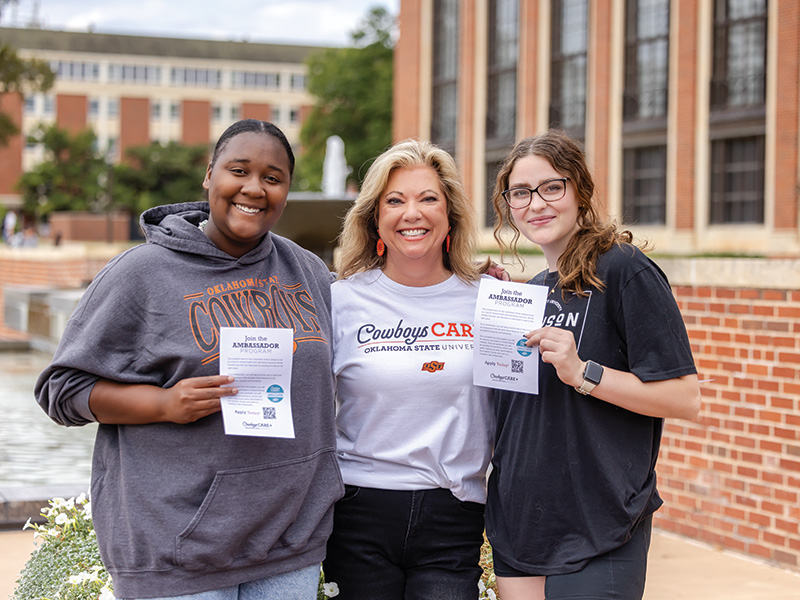
A key component in the initial discussions surrounding the initiative was the addition of an ambassador program. A group of individuals that would serve as a hub of resource information for those struggling and a first line of defense in the battle against the stigma of mental health.
A dream becomes a reality
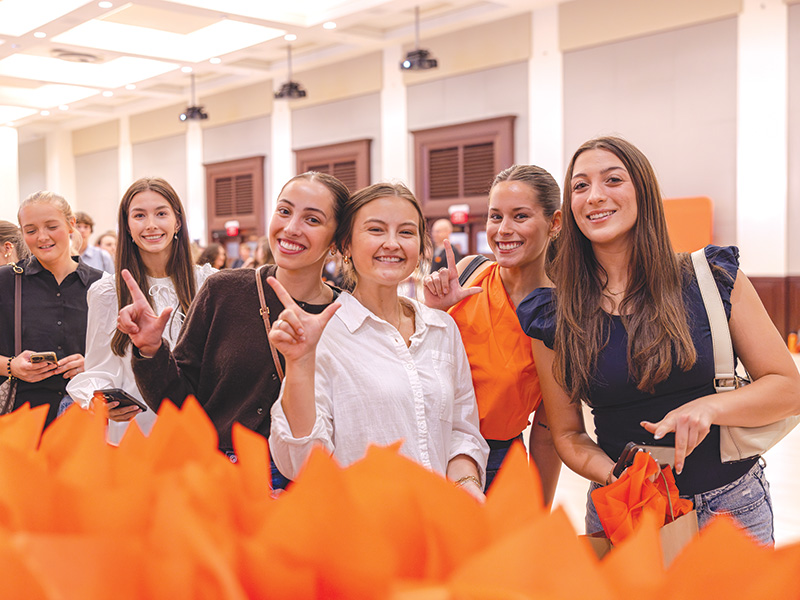
Two short months after the launch of this transformative initiative, the Cowboys Care team was ready to welcome its first cohort of Cowboys Care Ambassadors near the end of October — a perfect finish to Mental Health Awareness Month.
Nearly 100 faculty, staff and students comprised the cohort who graduated from the program inside the Student Union Ballroom.
“I am overjoyed and grateful,” Angela said. “To watch this initiative grow from an idea in the president’s office to where it is now, it’s truly amazing. Cowboys Care is officially a reality, and it’s thanks to our ambassadors.”
The ambassador program — open to all faculty, staff and students — is designed to provide anyone facing mental health issues another opportunity to connect with Cowboys Care resource information.
Ambassadors will display an orange bandana and a teal button on their person, backpack, briefcase or anywhere outward-facing. These items will serve as immediate, visual cues to others that the person is a Cowboys Care Ambassador and can help guide them to resources for assistance. Each item will also have a QR code that will link directly to the Cowboys Care website.
“The response to this program has been overwhelming,” Angela said. “I thought we’d get a handful of students to sign up to participate. Instead, we had nearly 100 who took the training to be an ambassador. It’s beyond my wildest dreams.”
As a member of the new cohort of ambassadors, Cooper P. Brandy is excited to be a part of this initiative and help others overcome their mental health struggles.
“The Cowboys Care initiative, in my opinion, is the most important initiative on campus,” said the political science freshman. “Mental health is such a universal struggle for all people in all walks of life. From students to faculty to staff, we all endure our own challenges. This initiative brings those challenges to the forefront of the conversation. It allows us to break down stigmas and openly discuss mental health.
“To be involved in the Cowboys Care Ambassador program is such an inspiring role to fill. Our role as ambassadors is more than to be a kind heart who people can open up to, but to actively seek out those in need and to do everything we can to ensure they are heard, understood and helped. Not only that, but to wear the bandana and pin is to be a beacon to others — it's a reminder that we're not in this alone.”
Angela hopes the program can be greatly impactful to the thousands of people who traverse campus on a daily basis.
The first cowgirl closed her comments at the ambassador graduation ceremony with a challenge and encouraging words from a mantra that has meant so much to her.
“Let’s lock arms and walk in the same direction of making mental health less of a stigma and more of a conversation,” Angela said. “As ambassadors, you are now the person who can say to someone who may be struggling, ‘I see you, I hear you and I’ll help you.’”
Go to the webpage for more information about Cowboys Care and mental health resources at OSU,
Photos by: Ellie Piper and Eric Priddy
Story by: Jeff Hopper | STATE Magazine